


Curriculum
Curriculum Information Sheet for Enrollment
Study plan for the Bachelor's Degree in Energy Engineering
The Energy Engineering Degree taught at the Higher Technical School of Engineering of the University of Seville within the Campus of Excellence Andalucía Tech has three mentions (also known as intensifications or specializations):
The degree is jointly offered by the Universities of Seville and Malaga. Students can begin their studies at either university and have the option of completing the final two years at the university where they started or at the other, depending on their chosen specialization.
A description of the mentions can be found in the following video
When registering online, the system displays all elective courses, regardless of whether they are part of the student's chosen specialization. Therefore, it is the student's responsibility to make the correct selection.
Specifically, completing one of the specializations is a prerequisite for obtaining the degree. Therefore, if a student mistakenly or intentionally completes the 240 credits by mixing courses from different specializations, they will not be eligible to receive the degree and will have to take additional courses to complete one of the specializations.
Therefore, it is strongly recommended that you carefully read the following guide before registering for third- or fourth-year courses. Any questions regarding this document can be submitted by email to jefaturaestudios-etsi@us.es or docencia-etsi@us.es.
The table shows the general structure of the studies. It displays five types of subjects, each color-coded:
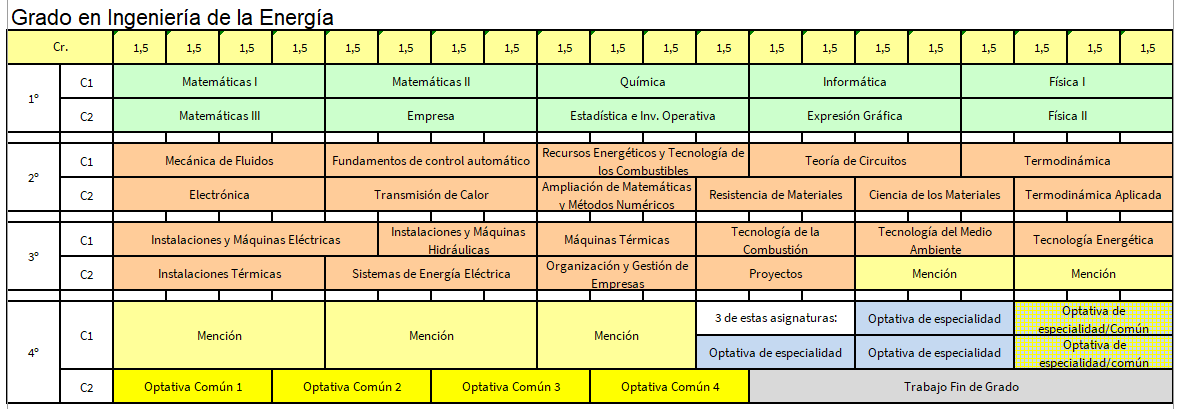
The subjects indicated in aqua green in the table (identified with the specific name of each subject) are basic training subjects that all students must take.
The subjects indicated in sienna background in the table (identified with the specific name of each subject) are compulsory subjects that all students must take.
The subjects highlighted in light yellow (Specific Technology) are the subjects for each specialization. Once a specialization is chosen, the subjects are unique and can therefore be considered "required for the specialization." These subjects are listed in the following sections for each specialization.
The subjects highlighted in blue-gray (specialization electives) are three 4.5-credit courses for which each student can choose from a different selection within their specialization. The following pages detail the subjects offered, although some may not be available in certain years. Their scheduling is also detailed, indicating which subjects will be taught concurrently and therefore cannot be taken simultaneously. Some of these subjects also serve as common or transversal electives. These are indicated in two colors in the corresponding grids below.
Subjects marked in dark yellow (Common Electives, also called transversal electives): Students may take one or more of the following options regardless of their chosen specialization (18 credits total): Transversal elective subjects: Each year, a list of subjects will be offered to provide complementary training.
These subjects may include:General subjects for all specializations
Specialization elective subjects that are offered to other specializations as common electives.
These are indicated in two colors in the corresponding grids below. They can be taken as a 9 ECTS credit course (normally corresponding to 9 weeks). Students must ensure they have been assigned a company before enrolling. To do so, they should contact the ETSi's external relations office. Academic recognition for extracurricular activities (cultural, sports, student representation, solidarity, and cooperation) is available up to a maximum of 6 credits, in accordance with university regulations. This also includes language accreditation at a level higher than the B1 required for the degree.
The Final Degree Project is worth 12 credits. It can only be submitted and assessed once the student has passed at least 70% of the total credits for the degree.
It is also noted that the required level of language skills to obtain this qualification is B1 in English, and other languages are not valid.


