
Aníbal Ollero invested Doctor Honoris Causa by the UMA
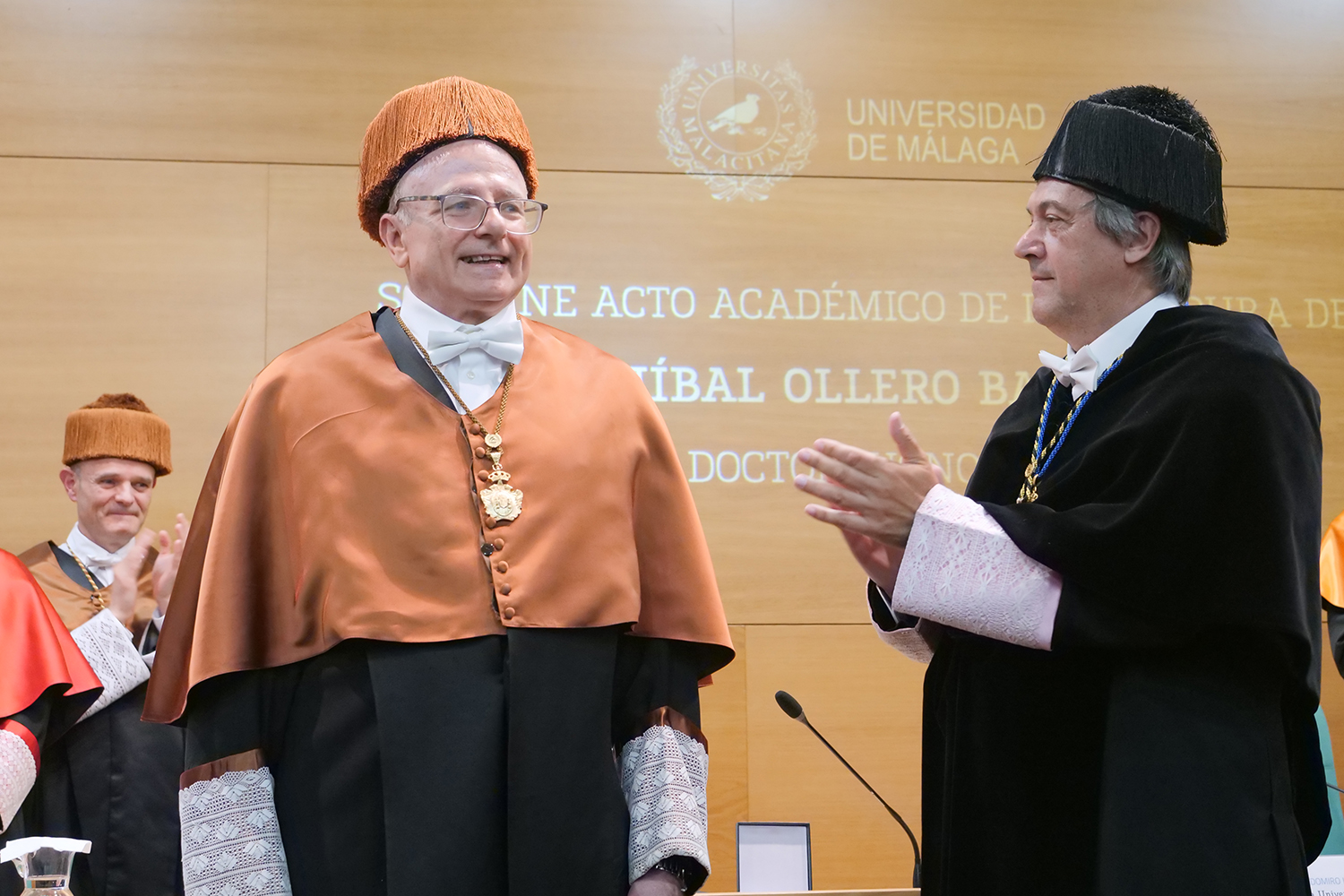
Aníbal Ollero Baturone, professor at the University of Seville and the researcher with more articles published worldwide related to non -manned air vehicles and aerial robotics, has been invested today as Doctor Honoris Causa by the University of Malaga.
The ceremony has followed all its protocol steps and has been chaired by the rector of the UMA, Teodomiro López. The honor of being his godfather has fallen to the professor of systems and automatic engineering of the Uma Alfonso García Cerezo. Both have given Ollero from the attributes and symbols that recognize their merits to be a Doctor Honoris Causa, such as the birrete laureate, the book of science, the ring, the white gloves and the doctoral medal.
The investiture has been attended by the Vice Chancellors for the Transfer of Knowledge and Research of the University of Seville, Felipe Rosa and Julián Martínez, respectively, in addition to members of the Directorate of the Higher Technical School of Engineering of the University of Seville, in which he teaches, as well as friends and partners of department.
Together with them, he has accompanied Professor Ollero a large group of academic and institutional representatives, with the mayor of Malaga, Francisco de la Torre, at the head, as well as the former rectors Adelaida de la Calle and José María Martín Delgado and the general director of Malaga Tech Park, Felipe Romera, who is also a Doctor Honoris Cause by the University of Malaga.
Aníbal Ollero is a world reference in the field of air robotics. He currently directs the GRVC (Robotics, Vision and Control Research Laboratory) - with more than 75 members of the Higher Technical Engineering School of the University of Seville - integrated into the Association for Industrial Research and Cooperation of Andalusia (AICIA). He is also scientific director of the Advanced Center for Aerospace Technologies (CATEC), with more than 130 components.
Leading researcher group in their field
His group is leader in Air Robotics. He has participated in more than 190 research and development projects, including 45 funded by the European Commission, as well as others sponsored by NASA, different national research programs (80) and other regional ones. In addition, he has been principal researcher in more than 50 contracts with industries.
It has presented results in more than 900 publications. Author or co -author of 11 books, has supervised more than 55 doctoral theses, including that of his godfather at the ceremony, Alfonso García Cerezo, who also highlighted his strong link with Malaga. In fact, he was the first director of the Superior Technical School of Industrial Engineers, Germ - together with the Polytechnic - of the current School of Industrial Engineering.
Going more to the content of his work, it should be noted that Ollero has developed methods, technologies and applications in non -manned air systems, robotics, control and autonomous systems in general, including the first smart robots of swinging wings with perched and handling capacity. It has also built aerial robots with land locomotion capacity for inspection and infrastructure maintenance, including electric lines and high pipes.
He has received about thirty awards and distinctions among which the Overall Innovation Radar Award Research Leonardo Torres Quevedo, in 2021.
Jobs
Explained the merits, and “crowned” already with the Birrete, Professor Ollero conducted an exhibition of some of his works, in a talk entitled 'Bio-inspired and deformable air robots' in which he has made clear his leadership in the field.
For his part, the rector of the UMA has pointed out that the recognition given by the University of Malaga "not only pays tribute to an exemplary trajectory, but also reflects the firm commitment of our institution with the great scientific, technological and social challenges of our time."
Ollero's link with science agglutina, according to Teodomiro López, "many of the values that we aspire to strengthen as university: academic excellence, ambition to innovate and social responsibility." "His person and his career - the rector continues - make robotics and automatic systems become transformative tools, put at the service of people and oriented to build a safer future."
"From their laboratories, not only intelligent drones have come out: true solutions have been born at the service of society, systems capable of intervening in forest fires, locating victims in extreme environments or collaborating in the reforestation of devastated areas," he added, while valued the ability of the new Honoris Causa Doctor to make a science that is not limited to mere discovery, "but also combines with the duty to protect, to protect and improve our lives".


