

Joint curriculum itinerary for the double degree
- Description. A curriculum is proposed to jointly pursue the University Master's Degrees in Industrial Engineering and in Thermal Energy Systems, based on the complementarity between both qualifications.
- Purpose. The completion of the program leads to obtaining the two qualifications that comprise it.
- The programming The teacher presents the following characteristics:
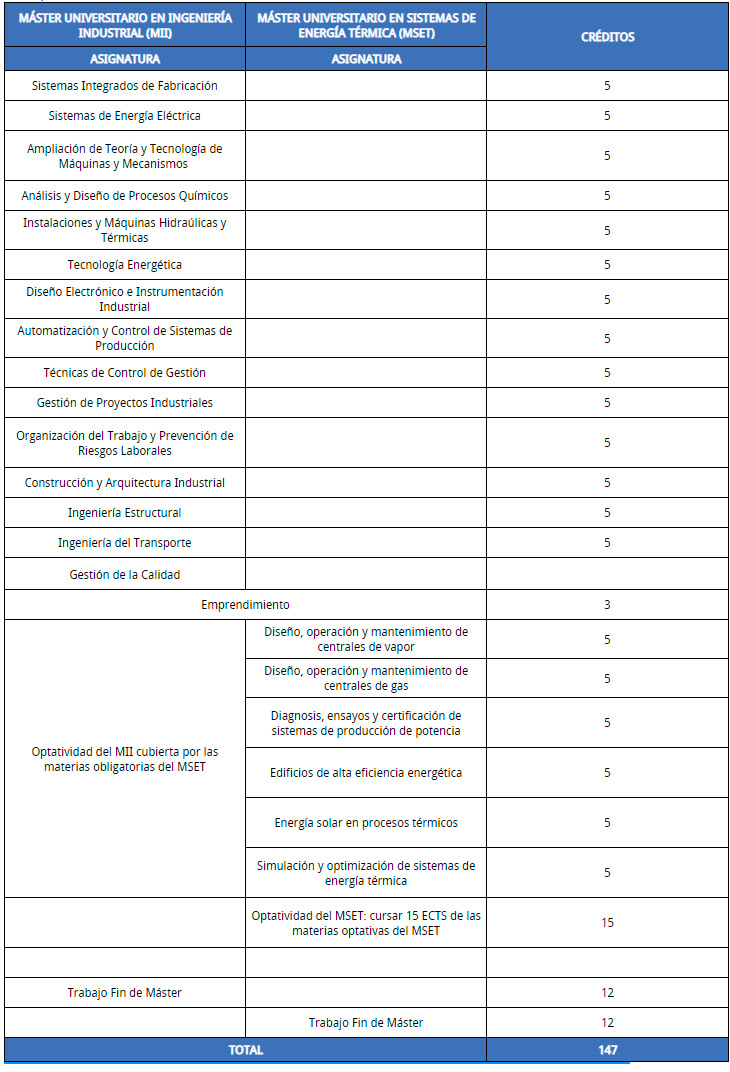
- The elective module (30 credits) of the Master's in Industrial Engineering will be completed using courses from the Master's in Thermal Energy Systems. This option is listed in the Master's in Industrial Engineering program description. The specific list of courses to be taken is as follows:
- Design, operation and maintenance of steam power plants
- Design, operation and maintenance of gas power plants
- Diagnosis, testing and certification of power production systems
- High energy efficiency buildings
- Solar energy in thermal processes
- Simulation and optimization of thermal energy systems
- The subject “Entrepreneurship”, worth 3 credits, is common to both master's degrees, so only the one corresponding to the Master in Thermal Energy Systems will be taken. The rest of the compulsory subjects from the Master in Industrial Engineering will be taken.
- The remaining compulsory subjects will be taken during the Master's in Industrial Engineering.
- Additionally, it is important to note that the Master's in Industrial Engineering includes a Bridging Block, comprised of subjects designed to ensure that all students in the Industrial Engineering program (which consists of the Bachelor's Degree in Industrial Technology Engineering plus the Master's in Industrial Engineering) acquire the same competencies, regardless of their undergraduate degree. These subjects, which are part of the elective module of the Master's in Industrial Engineering, must be taken, if deemed necessary by the Master's Academic Committee, in addition to the 147 credits of the double Master's degree as supplementary training. They are as follows:
- Complements to Rational Mechanics
- Numerical Methods
- Heat Transfer Accessories
- Manufacturing Technology Add-ons
- Electrical Technology Accessories
- Mathematics applied to Engineering
- The elective module (30 credits) of the Master's in Industrial Engineering will be completed using courses from the Master's in Thermal Energy Systems. This option is listed in the Master's in Industrial Engineering program description. The specific list of courses to be taken is as follows:
- Number of credits for the program. The total number of credits for the double Master's degree is 147.
- Access. As access requirements, it will be necessary to meet both the access requirements to the MII and those corresponding to the MSET, with the respective Academic Commissions retaining the powers over the evaluation of candidates and the establishment of training supplements and leveling subjects referred to in the verification reports, with the exception of the subjects specified in point 3d of this section, which will be considered as training supplements for the double Master's degree.
- Recommended entry profile. The dual degree program is geared towards students with prior undergraduate training in Energy Engineering, such as graduates in Industrial Technology Engineering with a specialization in Energy.
- Places offered. Initially, 5 places are planned for this double itinerary, a number that may be modified in subsequent courses depending on demand.
- Teaching organization.
- Groups. The MII courses will be taken concurrently with students pursuing that degree. Similarly, the MSET courses will be taught concurrently with students pursuing that degree. The timetable for these master's programs will be designed to avoid any scheduling conflicts for the dual degree.
- Academic bodies. Each degree will be managed by its corresponding Academic Committee, which, in relation to admission to studies and the specification of the Leveling Block for each student, will act in a coordinated manner.
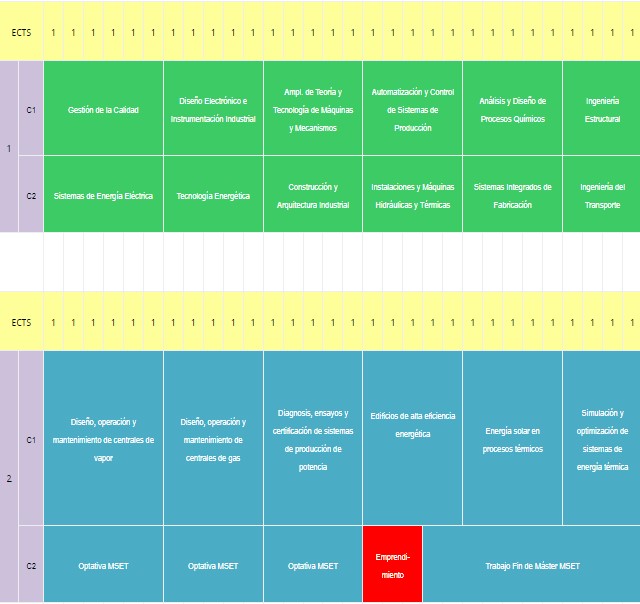
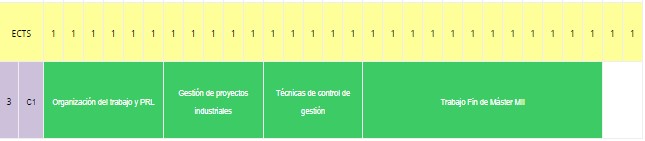
- Timetable for the teachingThe following tables show the timetable for the different subjects, indicating:
- Green: Subjects to be studied in the MII.
- Blue: Subjects to be studied at the MDAIM.
- Red: Common subjects.
Summary of the proposal (without leveling subjects)

*Includes 30 leveling credits to be taken according to prior training.


