

IBM 1130 Computer
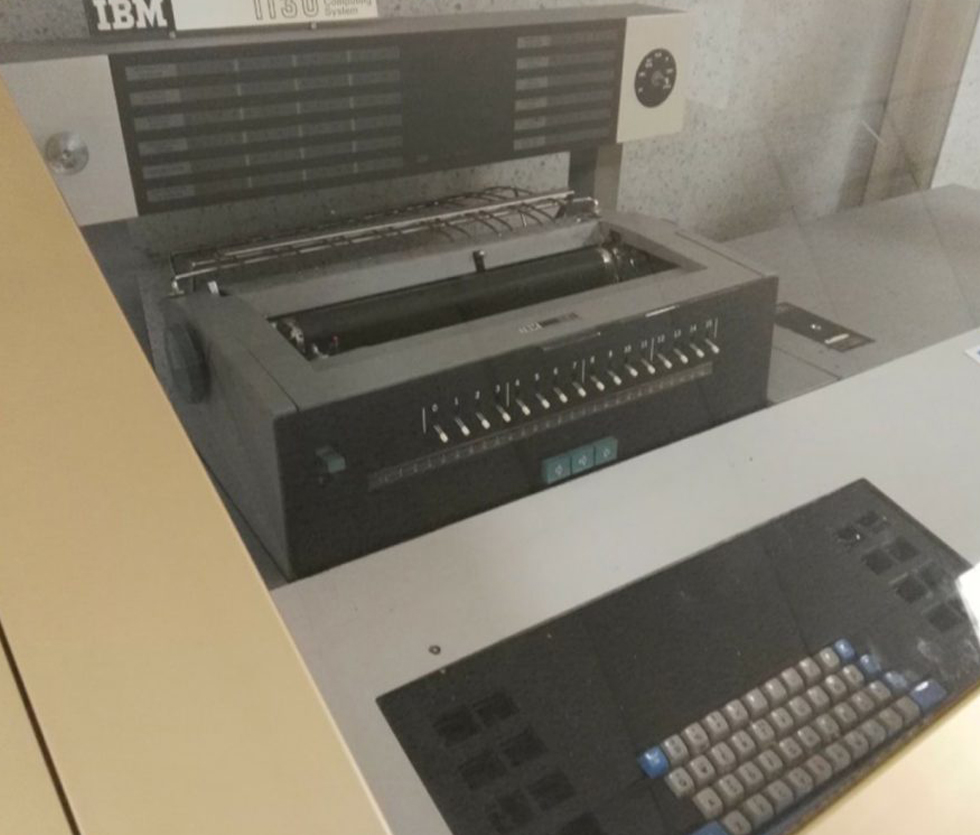
IBM 1131 Central Processing Unit
IBM 1132 Printer
- Device identification
Name: IBM 1130 Computer (IBM 1131 CPU and IBM 1132 Printer) (IBM 1130 Computer)
Location: Higher Technical School of Engineering, ETSI. Mezzanine 2
Origin: Acquired by the Higher School of Engineering of the US for its Data Processing and Communications Center (CPDC) created in 1969, now the Computing Center.
- Technical specifications
Measurements: 116.20 x 147.32 x 73.66 cm (general)
Material: Metal / Plastic / Electronic components
Use: Primarily for calculations in the fields of science, engineering, and education. This computer was in service at the ETSI for over 20 years, from its acquisition (c. 1979) until the late 1980s.
Overview: The IBM 1130 was the first desktop computer released by IBM on February 11, 1965. It was one of the first to use removable disk drives. It belongs to the so-called third generation of computers, which incorporated miniaturized circuits and technical advances in solid-state technology. It featured a 16-bit binary architecture and supported both direct and indirect addressing. Most of its programs were written in Fortran; other programming languages available on the 1130 included APL, BASIC, COBOL, FORTH, PL/I , and RPG.
The IBM 1131 Central Processing Unit (CPU ) had magnetic memory with a capacity of 16,384 locations, each with 16 cores, capable of storing 4 digits per location, for a total storage capacity of 65,536 digits. The access time to a memory location was 3.6 microseconds, allowing for 125,000 additions per second. IBM implemented five models of the 1131 CPU.
The complete line of peripherals included: – Auxiliary magnetic disk memory with a capacity of 512,000 memory locations, capable of storing 2,048,000 digits. – An IBM 1442 card reader/punch for serial card for input/output operations; it read at a rate of 400 cards per minute and punched 160 columns per second, that is, two complete cards per second. – An IBM 1627 plotter… – and an IBM 1132 printer, for line printing at up to 110 lines per minute and 120 characters per line. This printer was the lowest-priced offered by IBM up to that time (1965).

The IBM 1130 was many people's first experience with a computer. It was offered for rent (for less than $1,000) and, to a lesser extent, for sale (between $32,280 and $41,230 in 1965). The company offered financing options for its purchase.
- Cataloging-Documentation
Date: c. 1969-1972 / 1965 (IBM 1130 model release date)
Manufacturer/Brand: International Business Machines Corporation (IBM)
Country: United States
Serial Number and Model: IBM 1130
Technical description: Description of the IBM 1131 Central Processing Unit on a placard attached to the described equipment: “16-bit architecture. 15-bit addressable memory with a maximum memory of 64 kilobytes. Interchangeable hard disks, with storage capacity between 1 and 11 megabytes and a maximum transfer rate of 70 kilobytes. User programs were coded on punched cards, with the Fortran programming language…”
The 1131 Central Processing Unit was the main processing component of the IBM 1130 Computer System.
- Condition: Good. Displayed in a closed display case.
- Observations: In the inaugural lecture for the 1994-1995 academic year at the University of Seville, delivered by Professor José Cortés Gallego (A Classic Problem: The Number Pi), the author refers in one paragraph to this IBM 1130 computer: “…I would like to mention that around this time a Computing Center was already operating at the Higher Technical School of Industrial Engineers, using an IBM 1130 computer, on which I obtained some results with a matrix eigenvalue program that I had created myself. This first Computing Center was not for the entire University but only for Engineering students. Professors Quijada and Roballo, who were in charge, facilitated my access to this computer, which was already built with transistors, that is, it did not belong to that first generation. This constituted an important step for the computerization of our University. … It was temporarily installed in the Numerical Computing laboratory of the Faculty of Mathematics in the old Factory of "Tobacco, where we had to install two air conditioners and some humidity controllers. Shortly after, it was in the new Reina Mercedes building, and we could work more comfortably. In any case, although it was a very powerful computer, it was very laborious to run a program through the punched card system and have to send it to Madrid, waiting for a response in a queue that sometimes lasted up to 24 hours..."
- Bibliography and Sources / More information:
– * IBM1130.org . All about the IBM 1130 Computing System. Available at: http://ibm1130.org/ [Consulted: 03-22-2019]
– IBM. Data Processing Division. IBM 1130. Available at: http://media.ibm1130.org/E0002.pdf [Accessed 4-10-2016]
– IBM. IBM 1132 Printer. Instruction Manual. Available at: http://media.ibm1130.org/IBM%20227-3622-1%20FETO-MOI%201132%20printer.pdf [Accessed: 18-10-2016]
– Computer History Museum. Images and descriptions of the IBM 1130. Available at: http://www.computerhistory.org/revolution/minicomputers/11/358/1979 [Accessed: 22-03-2019]
– IBM 1130. Wikipedia. Available at: https://es.wikipedia.org/wiki/IBM_1130 [Accessed: 22-03-2019]
-Ulke, RE; Zarratea Herreros, A. The first steps of computing in Paraguay. Available at: http://www.abc.com.py/edicion-impresa/suplementos/mundo-digital/los-primeros-pasos-de-la-computacion-en-paraguay-849593.html [Accessed: 22-03-2019]