
Internal structure of «El Giraldillo» (1770-1998)
INTERNAL STRUCTURE OF “EL GIRALDILLO” (1770-1998)
- ID
Name: Internal structure of “El Giraldillo”: Stem and turning system
Location: Higher Technical School of Engineering (ETSI). Inner courtyard, West.
Origin: This one from 1770 is the second internal structure that El Giraldillo has historically had, a bronze sculpture with weathervane functions, in addition to aesthetic and symbolic ones, which crowns the bell tower of the Giralda.
During the extensive external and internal restoration to which the sculpture was subjected during the period 1998-2003 (IAPH), the structure was removed from the weathervane, conveniently studied and cleaned and replaced by the one currently in use.
The old pieces corresponding to the 2nd internal structure of the Giraldillo, which had been stored, were temporarily ceded to the ETSI by the Chapter of the SMPI Cathedral of Seville for their exhibition in the School on the occasion of the 25th anniversary of AICIA (Association of Research and Industrial Cooperation of Andalusia) in 2007.
Its assembly and placement in its current location was overseen by the School's professors, who had been part of the large interdisciplinary team responsible for the latter restoration process. The assembly was carried out by the company Joaquín Pérez e Hijos.
- Technical specifications
Measurements: 6.48 m. (5.4 m.: from the upper drum to the tip of the axle) // Weight: 835 Kgs. (Approx. 500 Kgs would be the weight of the stem or axle, from the upper cross of the Plume body to its upper end).
Material: Wrought iron
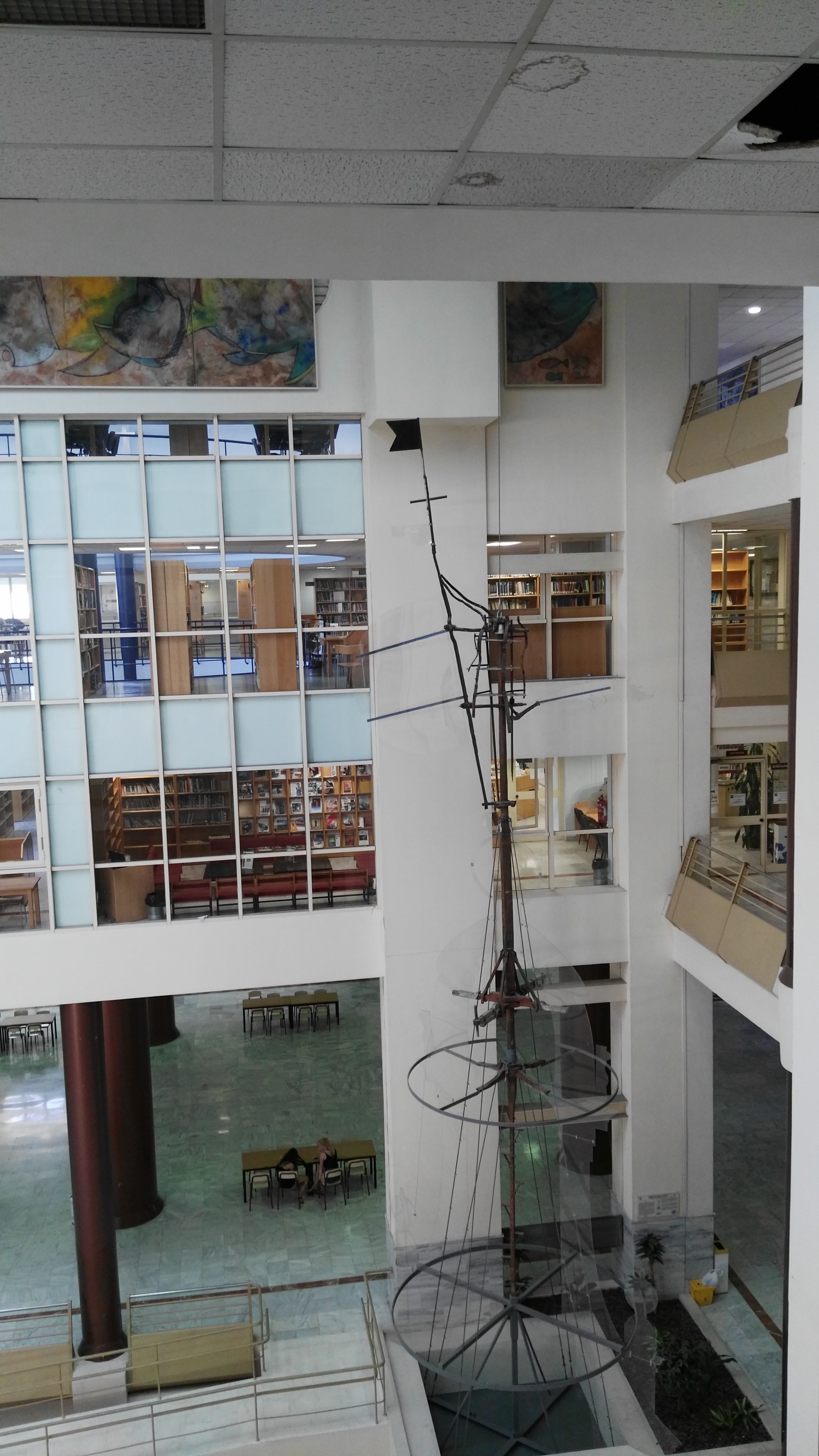
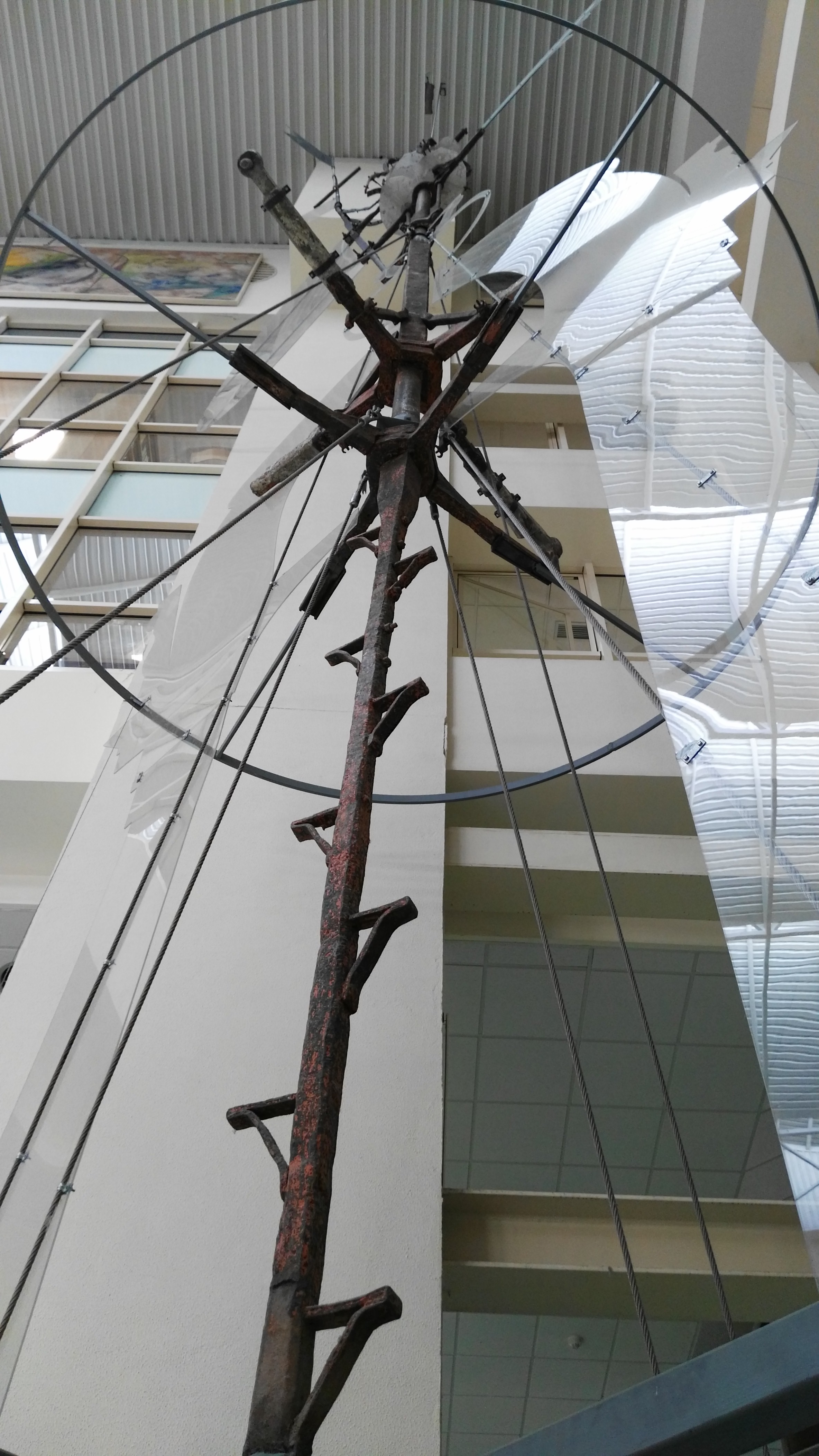
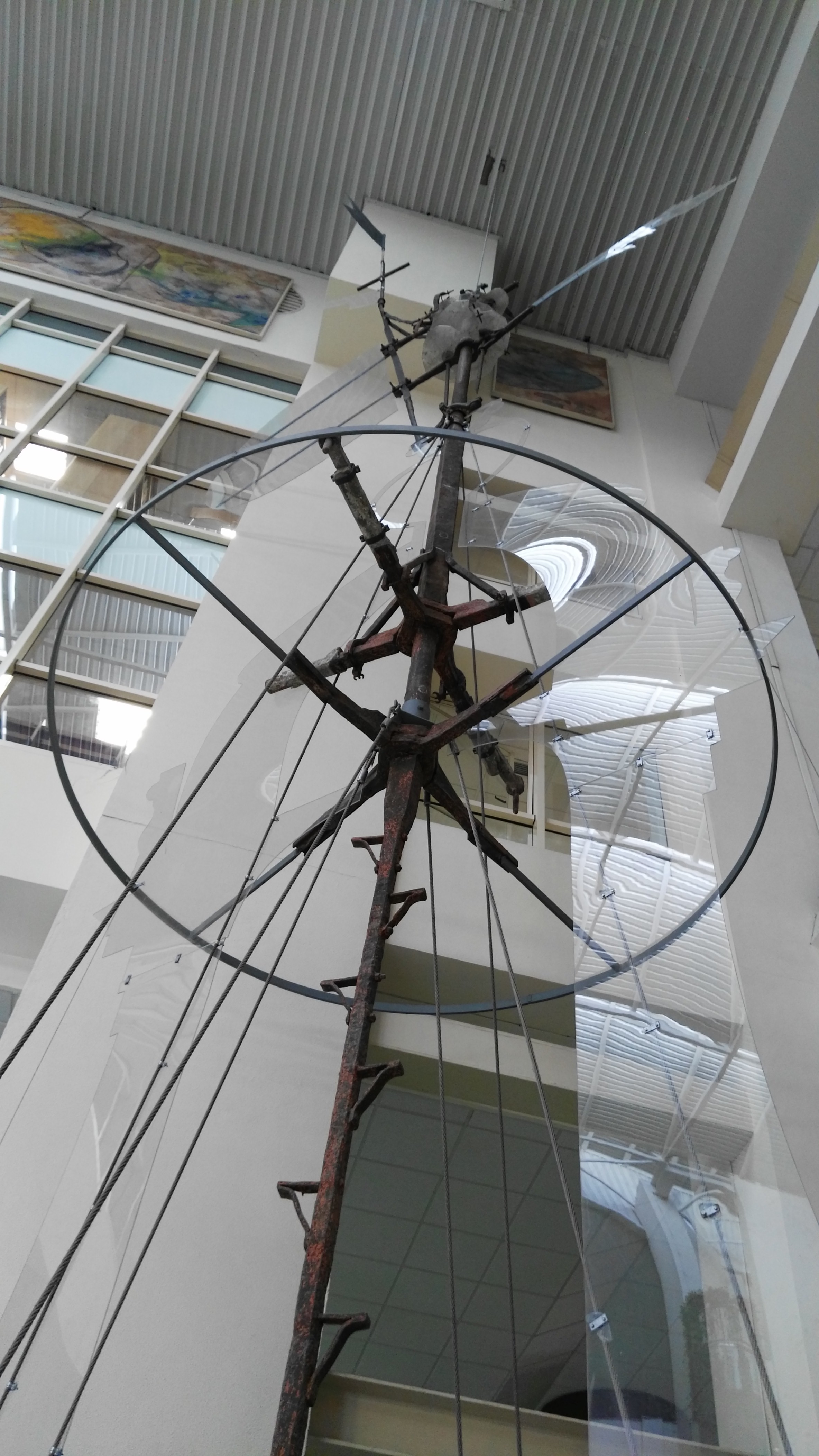
It is displayed held up with straps and surrounded by a methacrylate silhouette that gives an idea of its original position inside the Giraldillo sculpture.
Use: For almost three centuries, from 1700 to 1998, this bar structure served as the supporting axis and rotation system that allowed the movement of the sculpture (and weathervane) atop the Giralda bell tower. This internal pin or axle, with a variable diameter and a minimum of 7 cm, supported and enabled the rotation of the enormous bronze statue, 3.5 meters tall and weighing 1,705 kg. [Large bronze sculptures are hollow. The bronze skin, only a few centimeters thick, is not capable of supporting the weight of the figure, so it must be internally reinforced with an iron (or steel in more recent times) structure.] The structure was considered a "mechanical marvel" at the time, given that the rotating mechanism it incorporated represented a significant technological innovation.
General description: The internal structure formed a kind of hanger from which the bronze sculpture of the Giraldillo was suspended. It is composed of three more or less horizontal elements (crossbars) that passed through the body at different heights, and three approximately vertical elements (internal braces and flagpole ) that connected the former to each other. All of these elements are wrought iron, handcrafted, and therefore have neither a constant cross-section nor a regular geometry.
– The crossbars are located at the height of the feet, thighs and chest of the Giraldillo.
– The axle, embedded in the tower, passes through the two lower crossbeams via the rings in their central part and ends in the shape of an ogival point, which fits into the central bronze piece of the upper crossbeam at chest height, being the only vertical support point and pivot bearing of the sculpture and its internal structure.
– On the lower horizontal crossbar rested part of the feet of the Giraldillo, and at one of its ends is attached the bar that serves as the mast of the labarum or flag.
The intermediate crossbar has a descending trajectory from left to right. It joined the bronze of the sculpture on the left thigh and passed through it on the right, reaching the element that connected it to the mast and the flag by means of a pair of screws. Also at this height, the bar inside the sculpture's palm was joined to the left inner brace by means of a triangulation that constituted one of the structure's deficiencies, as it did not properly fulfill its function of transmitting the weight of the palm, and the force of the wind acting upon it, to the internal structure.
The upper crossbar at chest height, as previously mentioned, had a hollow in its center where the bronze bearing was housed (and still is, as it is the only element remaining in the current structure). This bearing held the end of the axle, forming the weathervane's pivot bearing. This crossbar was joined to the bronze sculpture at the left shoulder, passed through the sculpture's arm, which rested on the crossbar by means of wedges, and, like the intermediate crossbar, was attached by screws to the flagpole and the structure of the standard.
The internal braces and the flagpole connected the transverse elements. They were generally found to be in a satisfactory state of preservation, with the exception of the extremely high degree of corrosion on the lower end of the left brace, which passed through the left leg of the Giraldillo, and which had completely disappeared. This prevented the correct transmission of forces between the lower and intermediate crossbeams, causing imbalance and malfunction of the assembly.
– Internal reinforcements in the form of staves ran throughout the structure. The staves or bands were attached to the sculpture with rivets. They were placed in 1770 to reinforce deteriorated areas of the sculpture that showed cracks or missing material.
The sculpture, with its internal structure, is very well balanced, as the center of gravity of the whole is located laterally, 2 cm from the position of the weathervane's axis. The imbalance that causes the statue to lean towards the side of the flag and the slight inclination towards its rear are minor given the complex geometry of the piece, its era, and its construction process. From a technical point of view, its design as a weathervane was successful and its construction precise. (Domínguez Abascal, José; Solís Muñiz, Mario, 2009)
- Cataloging-Documentation
Date: 1770
Manufacturer/Brand: Author unknown
Country: Spain. City: Seville
Serial Number and Model: ——
Technical description: Information also derived mainly from studies published after the last restoration process of the Giraldillo in which the structure was replaced.
The removal of the 1770 internal structure constituted the first phase of the comprehensive restoration of the Giraldillo (1998-2003), as a preliminary step to allow for the interior and exterior cleaning of the sculpture. Although conceived as a demountable unit, its dismantling was a very laborious process due to the poor state of preservation of the joints between the different pieces, because some had been welded in later restorations, and because the mechanical operations and manipulations could not affect or damage this sculpture, the crowning element of the Giralda, declared an Asset of Cultural Interest and a World Heritage Site.
The Giraldillo remained in a horizontal position throughout the entire process of studying, dismantling, creating, and reassembling the new structure. First, the iron staves that reinforced the sculpture internally, all of which were severely corroded, were removed through the hole in the chest or the small door in the right hip. Subsequently, the pieces that connected the structural bars to the sculpture, functioning as bushings and wedges, were removed.
Dismantling the bar structure required cutting off the threaded ends of its components due to corrosion of the nuts that joined them. Once the structure was completely dismantled, the cut pieces would be welded back together so that the internal structure from 1770 could be viewed in its entirety.
To extract the structural section inside, the so-called "fabric knot" on the left side of the statue and part of the sheet metal covering its lower portion had to be dismantled. A fragment of iron metal from the original 1565 structure was found near the sculpture's left shoulder.
The large piece in the chest area, where the bearing on which the sculpture rotated was located—a function lost some years ago—had to be removed after the copper sheet covering it was soldered off. Dismantling the structure allowed for an examination of its details and state of preservation. In addition to revealing the inadequate design of some elements, the high level of oxidation throughout the entire piece was observed, with spectacular corrosion in some areas, such as the aforementioned lower end of the left support, which had disappeared.
One could also appreciate “the complexity of the geometry and its magnificent execution, not only because of the shape of each element separately (with breaks in its trajectory, changes in section, shape of the joints, etc.), but also because of the arrangement of the whole: there is an absolute absence of parallelism or orthogonality in the trajectories of the elements, which are conditioned as is logical by the shape of the sculpture.” (Domínguez Abascal, José ; Solís Muñiz, Mario, 2009).
– Cleaning of the old structure: A specific treatment for ferrous materials was applied. A surface cleaning removed residues such as the red lead applied in previous interventions. Several alterations were mechanically treated: adhesions, exfoliation, oxides… Subsequently, the iron was stabilized with 5% tannic oxide in alcohol and the metal was protected with acrylic resin and microcrystalline wax.
The analysis of its original internal structure and its mechanical behavior under different loads, using a finite element model, provided the necessary information to design and build the new support and rotation structure for the Giraldillo, which also restored its function and mobility as a weathervane. The new Giraldillo structure largely respects the design of the original 1770 structure (a criterion of minimal intervention in the restoration), although with certain modifications that correct some deficiencies and improve its interaction with the sculpture. It is made of AISI 316L stainless steel. It includes a remote control and inspection system with sensors to monitor the weathervane's operation, record the loads it is subjected to, and detect any potential damage. A program of periodic inspections was also planned.
- Condition: Good
- Observations: 5.1. Brief History: – As previously mentioned, this structure replaced the original internal structure of the bronze sculpture known today as El Giraldillo (because it rotates), also historically called “The Colossus of Victorious Faith,” Saint Joan, etc., created in the mid-16th century (1565-1568). Built before the sculpture, in 1565, it was the work of blacksmiths Juan Pozo and Cosme de Çorribas. – The passage of time (almost two centuries) and the Lisbon Earthquake of 1755 had led the original structure to a state of corrosion and deterioration, perfectly documented, which warranted its replacement. The intervention was carried out by Pedro Miguel Guerrero, author of the diagnosis and designer of the structure, and Manuel Núñez, Master Builder of the Cathedral, in charge of its dismantling and reassembly. * A color drawing with extensive caption, made by Pedro Miguel Guerrero and preserved in the Archive of the Seville Cathedral, contains drawings of the original and new structures and provides detailed information on this 1770 restoration of the "Flag, Bolt, Statue, and attachments…", also indicating that it offers "...a precise explanation of the order in which they were placed, which will serve to assemble and disassemble with ease and good economy the entire upper part of said Tower, when some accident of the times requires it…" - Image credit: Old photos and postcards of Seville]. 5.2. Next to the location where the internal structure of the Giraldillo is installed at the ETSI (School of Engineering), there is an information plaque entitled “Giralda Stem and Giraldillo Rotating System (1770-1998),” which describes its shape, technical characteristics, considerations regarding its location and manufacturing process, and its parts and elements. It also states that the lower crossbar section and the bolt on which it rests do not date from 1770, but are a replica of the one replaced in 1886 by Fernández Casanova, which is still installed in the Giraldillo today. In the background, the drawings and corresponding legend created after the restoration of the 1770 Giraldillo are visible, albeit blurred. 5.3. We conclude with the allusion to the weathervane mentioned in the Second Part of Don Quixote (Chapter 14), when the Knight of the Wood recounts to Don Quixote the commands of his beloved Casildea de Vandalia… in these terms: “…Once she ordered me to I went to challenge that famous giantess of Seville called the Giralda, who is as brave and strong as if made of bronze, and without moving from one place is the most mobile and fickle woman in the world. I arrived, saw her and conquered her, and made her stay put, because for more than a week only north winds blew…”
- Bibliography and Sources / More information:

-Bell ringers of Valencia Cathedral. The colossus of Seville [online]. 2016 Available at: http://campaners.com/php/textos.php?text=2138 [Accessed: 22-03-2019]
– The Giraldillo is also at the ETSI. Newsletter of the Higher Technical School of Engineers, no. 5 (April 2008), pp. 4-5. Available at: https://appsetsi.us.es/archivos/informacion/revistas/documentos/r05.pdf [Accessed: 30-09-2024]
– ** DOMÍNGUEZ ABASCAL, José; SOLÍS MUÑIZ, Mario. Mechanical-resistant behavior; Mechanical intervention. In El Giraldillo: the weathervane of time: research and intervention project. Andalusian Institute of Historical Heritage; (ed. coord., Rosario Villegas Sánchez; Román Fernández-Baca, dir.). – Seville: Ministry of Culture, 2009. PH Notebooks 24, Chapter 5 (pp. 103-138) and Chapter 7 (pp. 163-181). Available at: http://www.iaph.es/web/canales/publicaciones/cuadernos/cuadernos-ph/contenido/Cuadernos/CuadernoXXIV [Accessed 22-03-2019]
– El Giraldillo [online]. Blog Postcards and old photos of Seville, January 7, 2016. Available at: http://postalesyfotosantiguasdesevilla.blogspot.com.es/2016/01/el-giraldillo.html [Accessed: 22-03-2019]
– Andalusian Institute of Historical Heritage (IAPH). Catalogue of restored works. The Colossus of Victorious Faith. Available at: http://www.iaph.es/web/canales/conservacion-y-restauracion/catalogo-de-obras-restauradas/contenido/El_Giraldillo [Accessed: 22-03-2019]
– RODRÍGUEZ, Lola. Engineers rescue the authentic backbone of the Giraldillo from oblivion. ABC de Sevilla, May 25, 2008. Available at: https://sevilla.abc.es/home/sevi-ingenieros-rescata-olvido-autentica-espina-dorsal-giraldillo-200805250300-1641890980064_noticia.html [Accessed: September 30, 2024]