
BlueGuards Technologies triumphs at the European Innovation Academy 2025
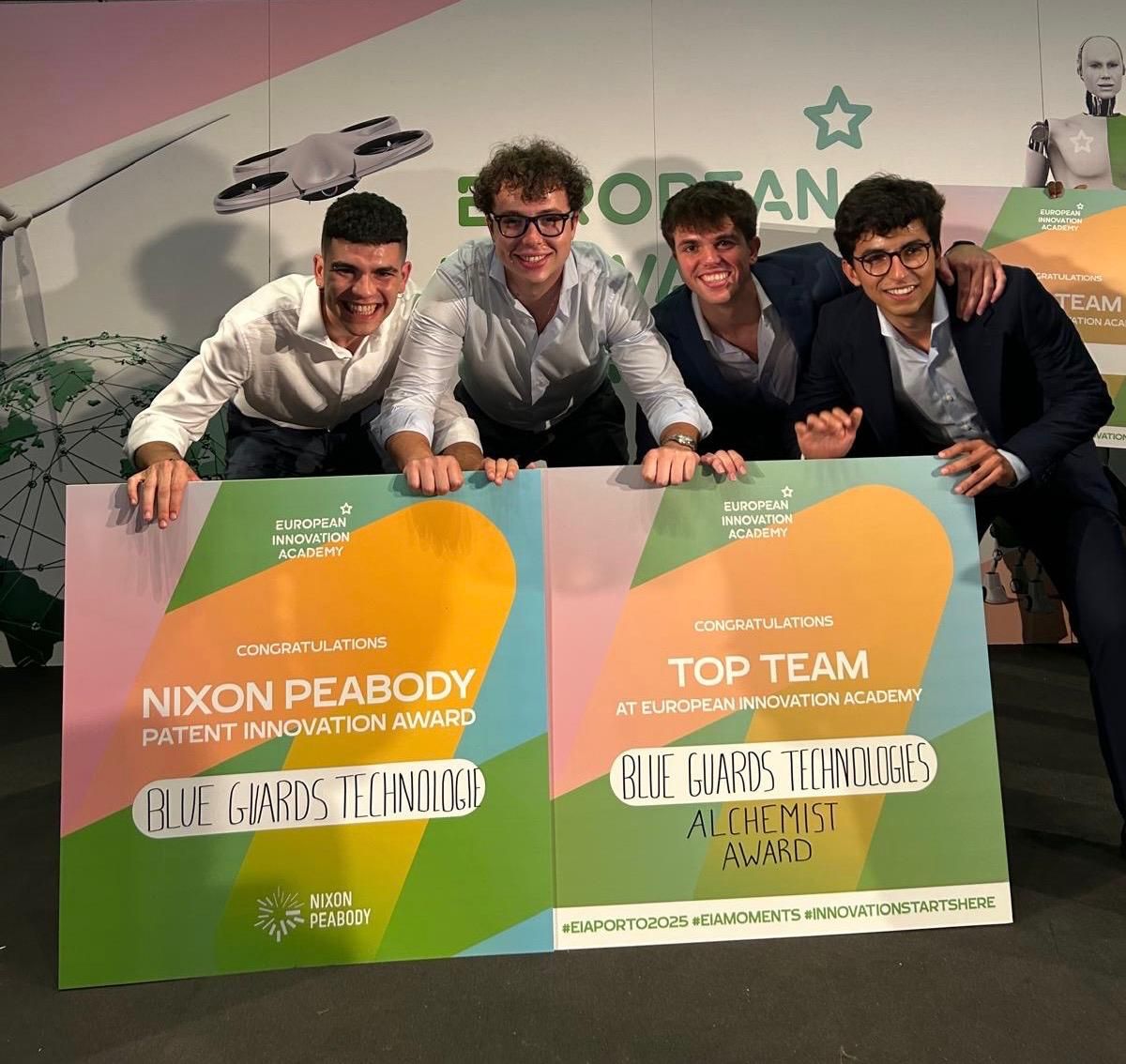
BlueGuards Technologies, an innovative initiative created by students from the Higher Technical School of Engineering at the University of Seville (ETSi), has been recognized with three awards at the European Innovation Academy (EIA) 2025, held in Porto last August. The team, made up of Fabio Esmeralda Martínez, Carlos Rodríguez Castillo, Guillermo Reina Paneque, and Carlos Cabrera Maldonado, had already won the Best Sustainable Project award at the ETSi's 1st Entrepreneurship Ideas Competition and were finalists in the 20th Entrepreneurship Ideas Competition organized by the Knowledge Transfer and Entrepreneurship Secretariat (STCE) of the University of Seville.
The EIA is Europe's largest academic accelerator for technological and digital entrepreneurship, with over 400 students from 64 countries working in international teams under the mentorship of experts from Google, Amazon, and Microsoft, and with the support of universities such as Stanford and Berkeley. Over three weeks, participants developed projects with an intensive focus on product validation, market strategy, and investor presentations.
BlueGuards Technologies became the most awarded team of this edition by obtaining the Top Team Award, which recognizes the best overall performance, leadership and collaborative ability; the Patent Innovation Award, granted by Nixon Peabody LLP, which provides them with financial and legal support to obtain the start-up's first patent; and the prestigious Alchemist Award, which distinguishes the project with the greatest potential for global impact and grants them priority access to the international incubator Alchemist Accelerator, a world reference for technological start-ups.
The project presented by the team, called BlueCycle, is a technological module designed for the lithium industry and focused on water recovery. It is a modular and autonomous vacuum evaporation system powered by solar energy, capable of recovering ultrapure water from waste brines. Its application aims to reduce water stress in the "Lithium Triangle" and offer a sustainable and replicable model for the industry. Currently, the technology is in the laboratory validation phase and is scheduled to begin field trials in 2026 in collaboration with universities and organizations in Chile and Argentina.
Following their experience at the EIA, BlueGuards Technologies is setting its sights on new goals: consolidating its legal structure, piloting BlueCycle under real-world conditions, expanding its international collaboration network, and raising awareness of the social and environmental impact of its proposal. The team expressed its gratitude to the University of Seville for the logistical and financial support received, as well as to the mentors and organizers of the program, who provided a crucial boost to the development of their project and their entrepreneurial journey.


