
The first meeting of STRATOLASER, the project aimed at removing space debris, was held at ETSi.
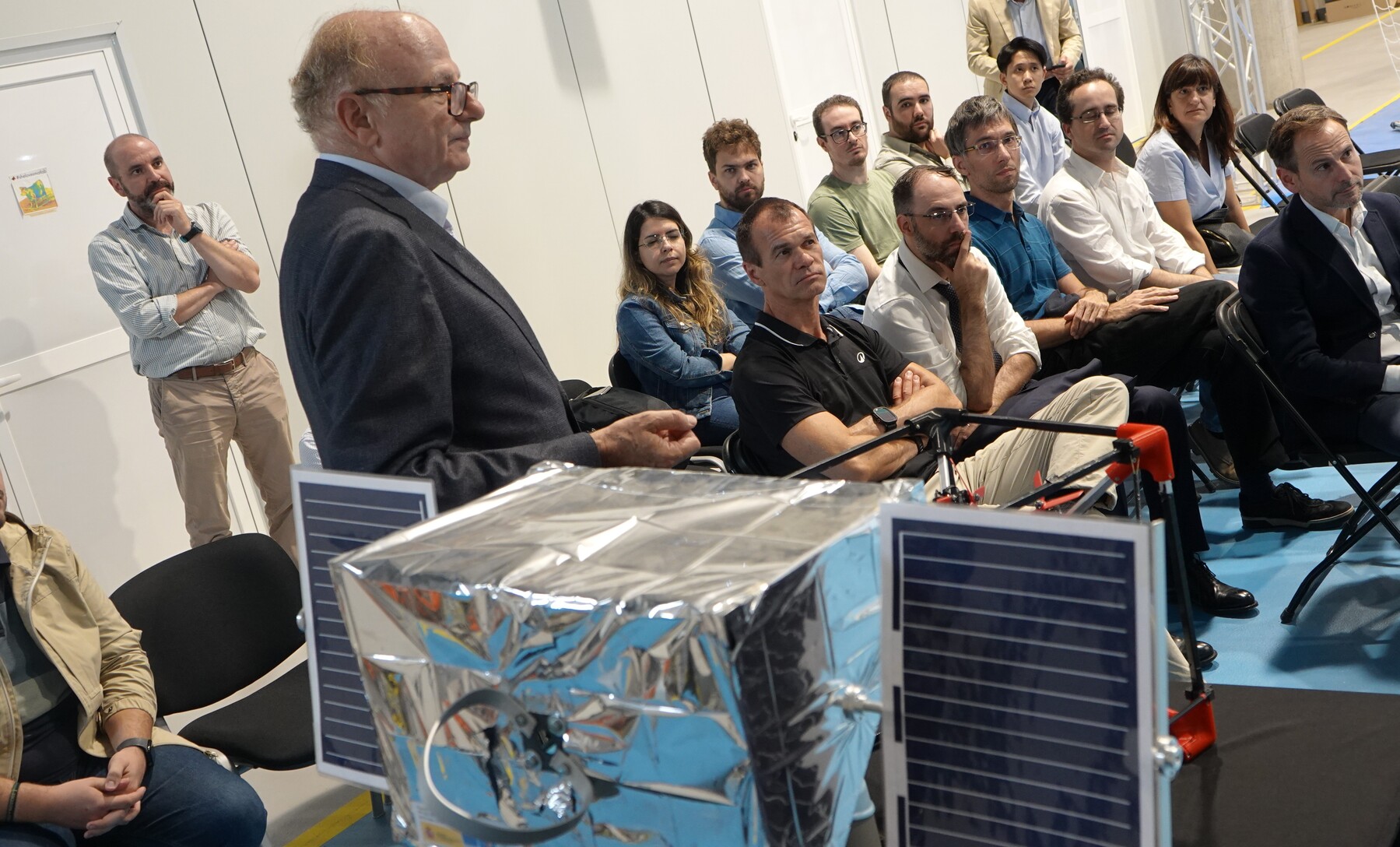
The first meeting of STRATOLASER, the project aimed at removing space debris, was held at ETSi.
STRATOLASER (Stratospheric balloon-based laser ablation system for space debris removal) is the new international project led by the GRVC Robotics Lab. With more than 2,500 decommissioned satellites, 36,500 pieces larger than 10 cm, and 1 million between 1 and 10 cm in size orbiting the Earth, space debris has become a problem that can threaten the safety of active space objects. STRATOLASER, a project within the EIC Pathfinder program and funded by the European Commission, aims to solve this problem through a novel approach: decelerating these remains by ablation using a state-of-the-art laser launched from Earth in a stratospheric balloon.
The first meeting, held on October 2 and 3 at the School of Engineering of the University of Seville, was attended by the international consortium of the project, as well as members of other organizations such as the European Space Agency.
This initiative aims to strengthen the protection of EU space infrastructure with reduced cost, lower maintenance, greater versatility, and broader orbital access compared to other space solutions thanks to the elimination of atmospheric attenuation and reduced laser beam dispersion. STRATOLASER will conduct the first experimental campaign to demonstrate the feasibility of the laser ablation stratospheric debris removal concept, reaching Technology Readiness Level (TRL) 4 and establishing the foundations for the technology. Using two stratospheric balloons, one with a debris fragment and the other with a small-scale pulsed laser and relay mirrors, the experiments will monitor ablation at different distances. Additional tests will include laser debris scanning.
orbitals, focusing on signal return without reaching the ablation threshold due to power limitations.
In addition to the leadership of the GRVC, this project benefits from the experience and technology of five major international partners. B2Space, responsible for the development of stratospheric balloons, the HiLASE Center and the Center for Pulsed Lasers (CLPU) will be responsible for laser technology and relay mirrors, while Fraunhofer FHR will be responsible for radar detection of space debris, and the Sapienza University of Rome will be responsible for calculating the debris retrieval orbits.
All these partners were present at the first STRATOLASER meeting, held on October 2 and 3 at the Spanish School of Engineering (ETSi). Experts from Airbus Defence and Space, CATEC, the German Aerospace Center (DLR), the Spanish Space Agency, and the European Space Agency (ESA) also participated. In addition to the presentations by each of the experts, the event focused on the organization of the different work packages, the structuring of tasks, and the deadlines for the first steps of the project. A visit to the GRVC Robotics Lab facilities was also included, allowing participants to learn about the group's latest projects, see a live demo of some of the robots its experts have created, and see the elements that will be part of the STRATOLASER development. This innovative initiative will be carried out over 36 months, and the next meeting, scheduled for March 2026 in the Czech Republic, will analyze the progress already underway.


