Joint curriculum itinerary for the double degree
- Description. A curriculum is proposed to jointly pursue the Master's Degrees in Industrial Engineering and Chemical Engineering, based on the complementarity between both degrees.
- Purpose. The completion of the program leads to obtaining the two qualifications that comprise it.
- The programming The teacher presents the following characteristics:
- From the Master in Chemical Engineering (MIQ) all compulsory subjects will be taken (37.5 credits), except Quality Management (4.5) and Work Organization (3), which will be taken through their respective compulsory subjects of the Master of Industrial Engineering (MII), Quality Management (5) and Work Organization and PRL (5).
- The elective module (30 ECTS) of the MIQ will be completed through compulsory courses offered in the MII and elective courses from the MIQ itself. This option is outlined in the Master in Chemical Engineering program description. The specific list of courses to be taken is as follows:
- Automation and Control of Production Systems (MII, 5 ECTS)
- Work placements in companies (MIQ, 15 ECTS)
- Hydraulic and thermal installations and machinery (MII, 5 ECTS)
- Energy Technology (MIQ, 4.5 ECTS)
- Refining and Petrochemicals (MIQ, 4.5 ECTS)
- The subject of Energy Technology (4.5 ECTS) is optional in the MIQ and is carried out by the compulsory subject of the MII, Energy Technology II (5 ECTS).
- All compulsory subjects will be taken in the MII program except:
- “Entrepreneurship”, worth 3 credits, which is common to both master's degrees, so only the one corresponding to the Master in Chemical Engineering will be taken.
- “Analysis and Design of Chemical Processes”, worth 5 credits, which is replaced by its MIQ equivalent “Engineering and Supervision of Chemical Plants” worth 6 credits.
- The elective module (30 ECTS) of the Master's in Chemical Engineering (MII) will be completed through required and elective courses offered in the Master's in Chemical Engineering (MIQ). This option is listed in the Master's in Chemical Engineering program documentation. The specific list of courses to be taken is as follows:
- Environmental Management in Industry (4.5 ECTS)
- Advanced simulation of chemical processes (6 ECTS)
- Reactor Engineering (4.5 ECTS)
- Advanced Separation Processes (4.5 ECTS)
- Integrated Process and Product Design (6 ECTS)
- Operation and Control of Chemical Plants (3 ECTS)
- Refining and Petrochemicals (4.5 ECTS)
- Additionally, it is important to note that the Master's in Industrial Engineering includes a Bridging Module, comprised of subjects designed to ensure that all students in the Industrial Engineering program (which consists of a Bachelor's Degree in Industrial Technology Engineering plus the Master's in Industrial Engineering) acquire the same competencies, regardless of their undergraduate degree. These subjects, which are part of the MII's elective module, are as follows:
- Complements to Rational Mechanics
- Numerical Methods
- Heat Transfer Accessories
- Manufacturing Technology Add-ons
- Electrical Technology Accessories
- Mathematics applied to engineering
- The Academic Committees of both master's programs will evaluate and determine which supplementary training subjects must be taken, in addition to the mandatory and optional credits of both master's programs.
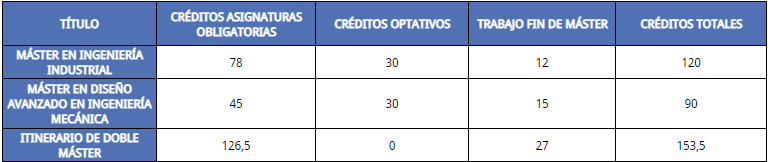
- The completion of two final master's projects is planned for the Double Master's degree, one for each title (12 + 15 ECTS).

- Number of credits for the program. The total number of credits for the double Master's degree is 153.5 credits, excluding supplementary courses. Certain subjects may be eligible for credit transfer depending on the subjects each student has taken in their previous degree.
- Admission. Admission requirements include meeting both the MII and MIQ entry requirements. The Joint Academic Committee will be responsible for evaluating candidates and establishing supplementary training and leveling courses, as outlined in the verification reports. The MII leveling courses will be considered supplementary training for the dual Master's degree; that is, while they are included within the 120 credits of the MII degree, they will be taken in addition to the 153.5 credits of the dual Master's program. In particular, preferential admission to this Dual Master's program (high preference) will be given to students with a Bachelor's degree in Chemical Engineering, as well as students with a Bachelor's degree in Industrial Technology Engineering specializing in Chemistry-Environment or Energy.
- Places offered. Initially, 5 places are planned for this double itinerary, a number that may be modified in subsequent courses depending on demand.
- Teaching organization.
- Groups. There will not be a separate group for this dual degree. The courses of the Master's Degree in Industrial Engineering will be taken jointly with students pursuing this degree as a single Master's program. Similarly, the courses of the Master's Degree in Chemical Engineering will be taught jointly to all students enrolled in this program. The timetables for these Master's programs will be designed to avoid any scheduling conflicts within the dual degree program.
- Academic bodies. Each degree will be managed by its corresponding Academic Committee, which will act jointly in relation to admission to studies and the specification of supplementary training for each student.
Summary of the proposal: