
Expert voices in the Aerospace field meet at the ETSi to address the situation of the sector in the city of Seville
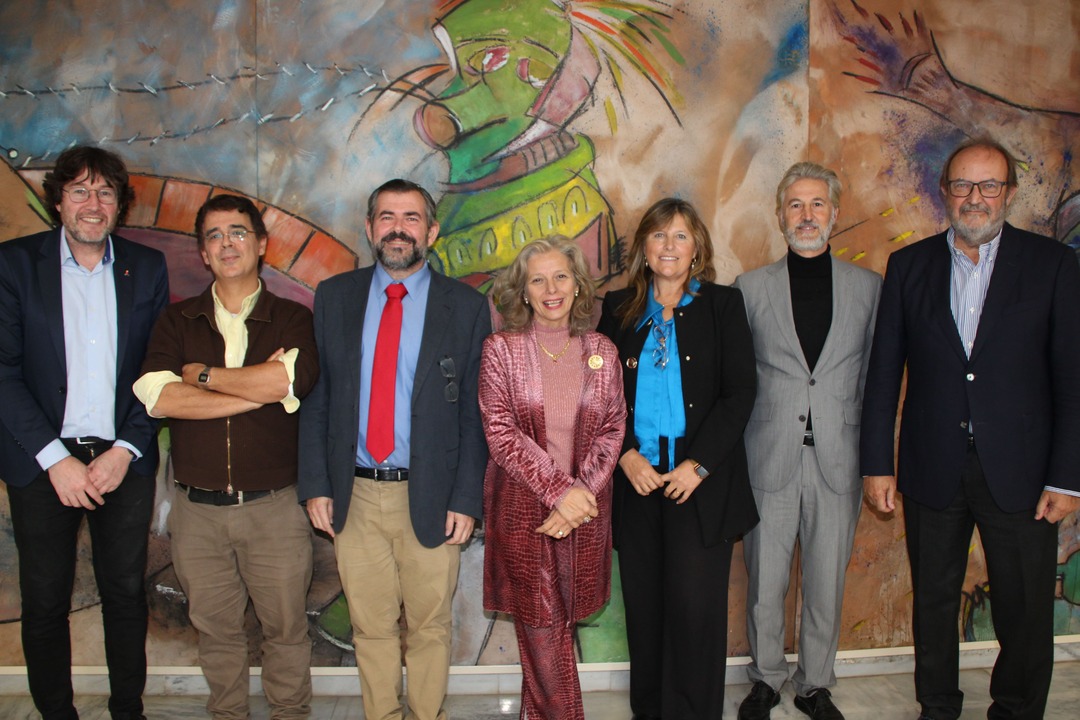
The Higher Technical School of Engineering of the University of Seville is hosting a Space Day today, November 6th, which, in a round table format, has brought together various expert voices in the sector to answer the most basic questions about the research being carried out at the ETSi in the aerospace field.
These sessions are being held in the context of the informal ministerial meeting on Space Competitiveness, which will bring together the relevant European Union ministers in Seville tomorrow, November 7, to discuss the measures that should be adopted to guarantee the continuity and strengthening of space-based infrastructure and services. This meeting is part of the activities surrounding Spain's Presidency of the Council of the EU
The event was opened by Maria Cruz Arcos Vargas, Director of the European Documentation Centre of the University of Seville and of Europedirect Seville, who, in response to the question, "Why Space Research?", explained the need for a European Space policy and its current framework within the EU.
In this regard, Maria Cruz Arcos compared the world of space to the ocean floor, stating, “Until we had the ability to access them, the need to legislate about them wasn't seen. Now we can access space, and it is urgent that the legislation be developed.”.
Arcos Vargas currently chairs the Andalusian Council of the European Movement and is a tenured professor of International Law and International Relations at the University of Seville.
The research activity of four research groups from the Higher Technical School of Engineering of the University of Seville was then presented.
The first of these was led by Federico Paris Carballo, Professor of Mechanics of Continuous Media and Theory of Structures at the University of Seville since 1982. In his presentation, Professor Paris detailed the problems presented by certain materials used in the space sector, with special emphasis on Carbon Fiber Composite Materials, as well as the requirements that must be met in aerospace structures.
From his experience as co-founder of TEAMS, he has also described what it means to transfer technology in this sector through a US spin-off.
Paris Carballo has stated that "Space can benefit from our contributions by using the materials we test to lighten loads and ensure they have sufficient strength.".
“On the other hand, we researchers have an educational role, opening up the world of space to the children who will be the future professionals in the sector. There, too, we have a great responsibility and a capacity to contribute,” he stated.
Next, José Manuel Quero Reboul, Professor of Electronic Engineering at the University of Seville, shared his more than 30 years of experience as a researcher, participating in several space missions and the development of various scientific payloads. Among other projects, he highlighted the CEPHEUS mission, in which he led the consortium that built the first nanosatellite developed in Andalusia, and the VECTORSOL project, where a solar sensor made with Microsystems Engineering (MEMS) technology was designed, built, and launched into orbit. This latter achievement served as the starting point for founding the Technology-Based Company (EBT) SOLARMEMS TECHNOLOGIES in 2009, a leading company in the manufacture of solar sensors for space applications.
Quero Reboul also explained NewSpace, the revolution currently underway in the space sector, and the emerging technological opportunities. “Access to space has been liberalized; we can say that the sector has been democratized, all thanks to the reduction in weight and costs compared to the past when launching a satellite into space. This step has allowed us to work in this field from our centers and see our technology in Earth orbit,” he stated.
For his part, Rafael Vázquez Valenzuela, Professor of Aerospace Engineering at the University of Seville, and Professor of Orbital Mechanics and Dynamics of Space Vehicles for the last 16 years at the ETSi, spoke to describe the evolution of the teaching and research of the Aerospace Engineering group at the ETSi, as well as the current lines of research and collaborations with companies, agencies and other key universities in the sector.
Vázquez Valenzuela has asserted that “the forecasts of the volume of what will be launched into space are chilling, so having technology that prevents satellite collisions, like the one we develop at ETSi, is fundamental, as well as international regulations.”.
Finally, Rogelio Palomo Pinto, professor of Electronic Systems for Aerospace Applications for the last 8 years at ETSI, was in charge of closing the presentation on multidisciplinary research in the aerospace field developed at ETSi, presenting the research activities in electronics for space environment of the Electronic Engineering group and the collaborations with companies, agencies and other key universities in the sector.
Palomo Pinto reiterated the need for legal coverage for the sector that encompasses all countries and professionals, asserting that “the war in space is already underway, making it urgent for institutions like the UN to establish common regulations for not only military but also civilian use. Space is an economic resource, and the major powers have been vying for it for some time now.”.
For her part, Esperanza Caro Gómez, Managing Director of the Seville Municipal Companies Corporation, recounted how the city of Seville became a leader in space-related matters and what strategy the city followed to attract the Spanish Space Agency to Seville. “It is the story of a collective success, one to which everyone has contributed: the School of Engineering, the University of Seville, the Regional Government of Andalusia, the State, etc. Furthermore, it is essential to highlight, among all of them, the figure of someone from this School who has been fundamental in making Seville the headquarters of the Spanish Space Agency today, and that is none other than the Professor of Energy Engineering, Carlos Gómez Camacho.”.


