


Teaching planning
The Master's program is structured as a 120 ECTS qualification (two academic years) with three specializations in the most relevant areas of Telecommunications Engineering. The three specializations are:
The Internet of Things (IoT) is completely changing society, affecting how we live and work. The term IoT refers to the existence of everyday devices and objects connected to the internet to collect and exchange information, and they have numerous industrial and social applications. This module will provide an in-depth study of IoT technologies, from both a hardware design perspective and the communication and processing of the data obtained. In this specialization, the course "Communications and Data Analysis in IoT" is taught in English.
Distributed Systems and Cybersecurity : Distributed systems are becoming increasingly established, especially due to the rise of cloud computing, which involves providing resources on demand, from applications to data centers, via the internet and with a pay-as-you-go model. The advantages of this model lie in the flexibility of available resources, which are used only when needed; payment is typically based on metered service; and the ever-expanding catalog of available resources. The diversity of cloud computing providers necessitates up-to-date knowledge to determine the quality of services offered by different providers. Furthermore, the possibility that data may not be located within the company itself reinforces the need to study cybersecurity mechanisms and apply command and control systems to this element. In this specialization, the AI Techniques in Distributed Systems course is taught in English.
Biomedical Engineering , or Biomedical Engineering , is the discipline that applies engineering principles and methods to solve problems in biology and medicine, and to improve methods of prevention, diagnosis, treatment, and rehabilitation. It is a constantly expanding field with a high demand for professionals capable of integrating into interdisciplinary teams to address new challenges in improving healthcare technology. In this module, whose specialization is taught entirely in English, knowledge of electronics, telematics, communications, and signal processing will be applied to solving biomedical problems.
The curriculum's timeline is as follows:
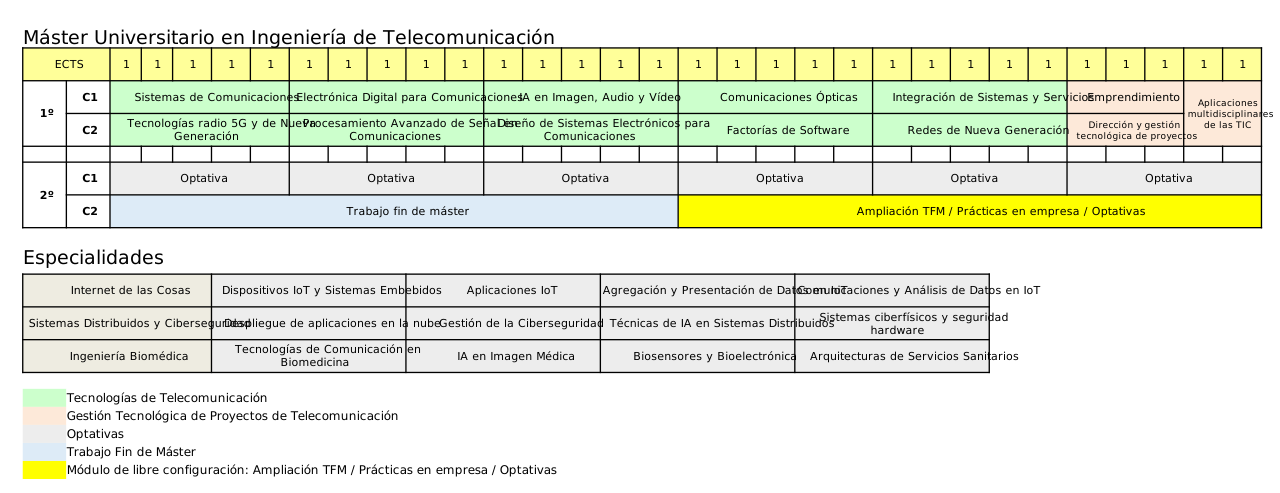
To obtain a specialization, students must complete the four subjects of their chosen specialization and two additional subjects from either of the other two specializations. However, it is possible to freely choose six of the twelve subjects and not pursue a specialization.


