

Joint curriculum itinerary for the double degree
- Description. A curriculum itinerary is proposed to jointly study the University Master's Degrees in Chemical Engineering (MIQ) and in Environmental Engineering (MIAMB), based on the complementarity between both degrees.
- Purpose. The completion of the program leads to obtaining the two qualifications that comprise it.
- The teaching program has the following characteristics:
- The Master in Chemical Engineering will consist of 45 ECTS credits of compulsory subjects.
- Of the elective module of the Master's in Chemical Engineering, 15 ECTS credits will be earned through required courses from the Master's in Environmental Engineering. This option is listed in the Master's in Chemical Engineering curriculum. The specific list of courses to be taken is as follows:
- Water treatment plant design 4.5
- Air pollution engineering 4.5
- Waste Engineering 3
- Life cycle analysis 3
- Biorefineries 3
- Industrial safety 4.5
- Advanced Biotechnology 4.5
- Circular economy and sustainability 4.5
- Energy and Environment 3
- The subject “Environmental Management in Industry” (4.5 ECTS) is transversal to both Masters.
- The subject “Entrepreneurship” (3 ECTS) is common to both master's degrees, so only one of them will be taken.
- The remaining compulsory subjects will be taken from the Master in Environmental Engineering (Environmental quality assessment, 3 ECTS).
- The Internship and Placement Module of the Master's in Chemical Engineering is worth 15 ECTS credits. This module facilitates student mobility, introduces them to research, and prepares them for entry into the professional world. It offers the following options:
- Communication Techniques and Professional Skills: 5 credits
- Internships in companies or public institutions: up to 15 credits
- Stays in research laboratories of public bodies, universities or companies: up to 15 credits
- Subjects taken in mobility programs: up to 15 credits
- Supplement to Master's Thesis completed in mobility programs: 15 credits
- The completion of two Master's theses is planned for the Double Master's degree, one for each title (15 + 15 ECTS).
- It should be noted that the Master's in Environmental Engineering includes a supplementary training course, which is the subject:
- Analysis and Design of Chemical Processes
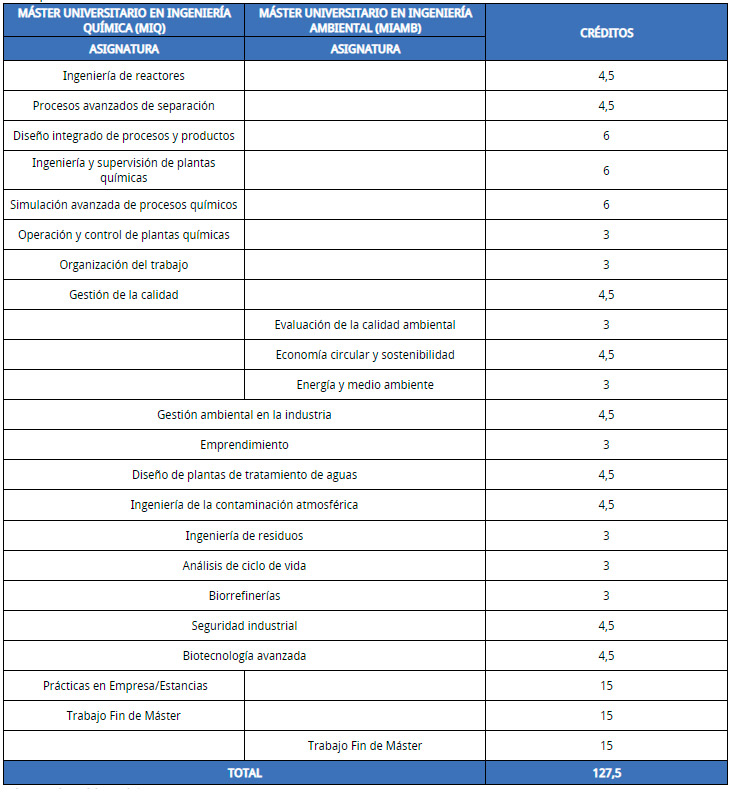
- Number of credits for the program. The total number of credits for the double Master's degree is 127.5 ECTS.
- Access. As access requirements, it will be necessary to meet both the access requirements to the MIQ and those corresponding to the MIAMB, with the respective Academic Commissions retaining the powers regarding the evaluation of candidates and the establishment of training supplements referred to in the verification reports.
- Recommended entry profile. The dual degree program is geared towards students with prior undergraduate training in Chemical Engineering and graduates in Industrial Chemical Engineering.
- Places offered. Initially, 10 places are planned for this dual itinerary, a number that may be modified in subsequent courses depending on demand.
- Teaching organization.
- Groups. MIQ courses will be taken concurrently with students pursuing that degree. Similarly, MIAMB courses will be taught concurrently with students pursuing that degree. The timetable for these master's programs will be designed to avoid scheduling conflicts for the dual degree.
- Academic bodies. Each degree will be managed by its corresponding Academic Committee, which is responsible for admission to studies.
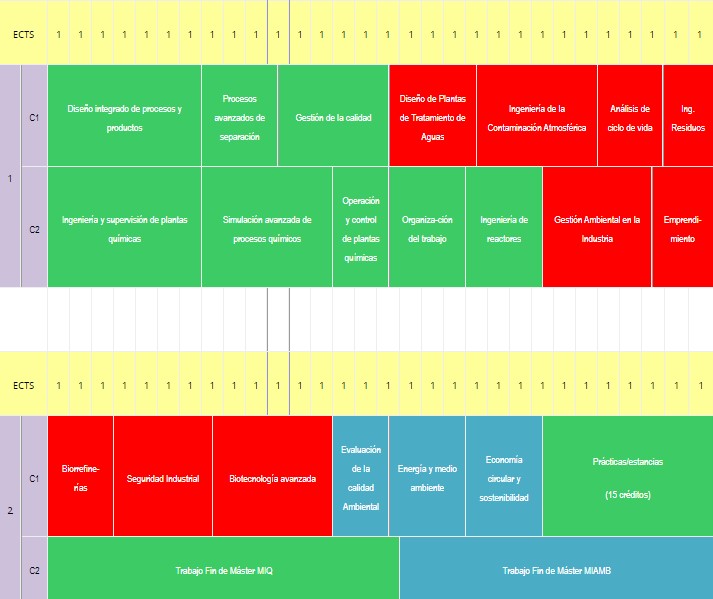
- Timetable for the teachingThe following tables show the timetable for the different subjects, indicating:
- Green: Subjects to be studied in the MII.
- Blue: Subjects to be studied at MIAMB.
- Red: Common subjects.
Summary of the proposal (without leveling subjects)
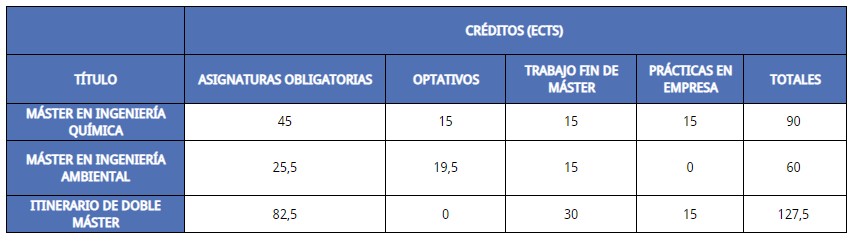
*Includes 30 leveling credits to be taken according to prior training.


