
The Seville team wins the National Roads Olympiad held at the ETSi for the second year in a row
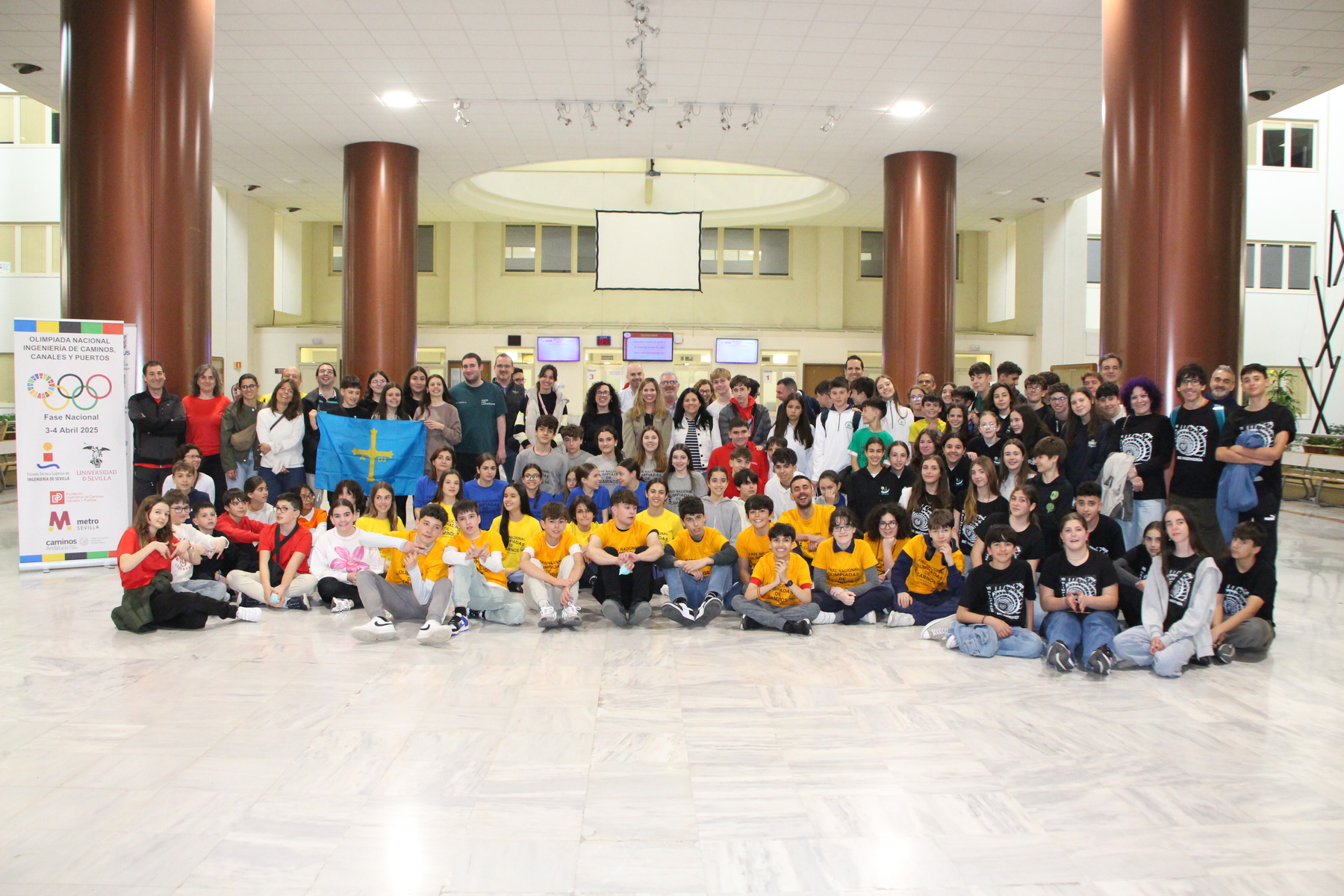
The Seville team wins the National Civil Engineering Olympiad for the second year in a row, held at the ETSi
The Higher Technical School of Engineering of the University of Seville has been in charge of organizing the VII National Engineering Olympiad of Roads, Canals and Ports, an activity aimed at students of Compulsory Secondary Education and which seeks to promote the profession and the university environment among students who are close to choosing the degree they will study in their next academic stage.
After the various tests were completed, the scores showed that the team representing the University of Seville, made up of students from the Punta del Verde Institute, won first place for the second year in a row, followed by the teams from Burgos and Cartagena. Therefore, and because the Olympiad regulations stipulate that host cities cannot repeat, the University of Granada, which finished fourth, will be responsible for organizing the next edition in 2026, as the first three cities have recently hosted the event.
More than 80 young people from secondary education centers have participated in one of the 14 teams that have faced each other in the tests that make up the competition, the origin of the venues being the cities that have higher studies of Civil Engineering, Canals and Ports (Seville, Granada, Cartagena, Alicante, Valencia, Barcelona, Madrid, Burgos, Santander, Oviedo, Cadiz, A Coruña, Cadiz and Ciudad Real).
The holding of this Olympiad is in line with the Sustainable Development Goals (SDGs), which constitute a universal call to action to end poverty, protect the planet and improve the lives and prospects of people around the world. These six events that make up the Olympics are related to 8 of the 17 SDGs defined in the 2030 Agenda for Sustainable Development by the UN adopted in 2015.
In this way, the students had to overcome the following challenges:
Test 1 “Voussoir Arch”: Construction Engineering (SDGs 8, 9, 11 and 17).
Test 2 “Da Vinci Bridge”: Structural Engineering (SDGs 8, 9, 11 and 17).
Test 3 “Dam-Edam”: Hydraulic Engineering (SDGs 6, 8, 11 and 17).
Test 4 “Road engineering and its works”: Graphic engineering (SDGs 5, 6, 7, 9, 11, 13 and 17).
Test 5 “LogisTIC”: Transport of goods, efficient logistics (SDGs 8, 11, 13 and 17).
Test 6 “Playing at being an engineer”: Computer-assisted project (SDGs 4, 8 and 17).
Test 7: “Surprise” Sponsored by Metro de Sevilla.
One of the objectives of the Olympiad is to test the quick response and structural intuition of different groups of secondary school students working in teams. The tests vary in difficulty, but they allow us to understand the participants' leadership roles, their approach to problems, their teamwork skills, their ability to adapt to limited resources and tools, and so on.
In addition to promoting the profession of Civil Engineering among young people, STEM degrees, and facilitating a first approach of secondary school students to the university academic world, the linking of these tests with the SDGs established in the 2030 Agenda by the UN, involves students in working for a common good and integrating these objectives into their present as aspiring to be the new professionals of the society of the future.
The celebration of this National Olympiad has been supported by the Official College of Civil Engineers, Canals and Ports (COICCP) and Metro de Sevilla.


