
The GRVC Robotics Laboratory of the ETSI organizes the closing of the international AERIAL-CORE project at ATLAS
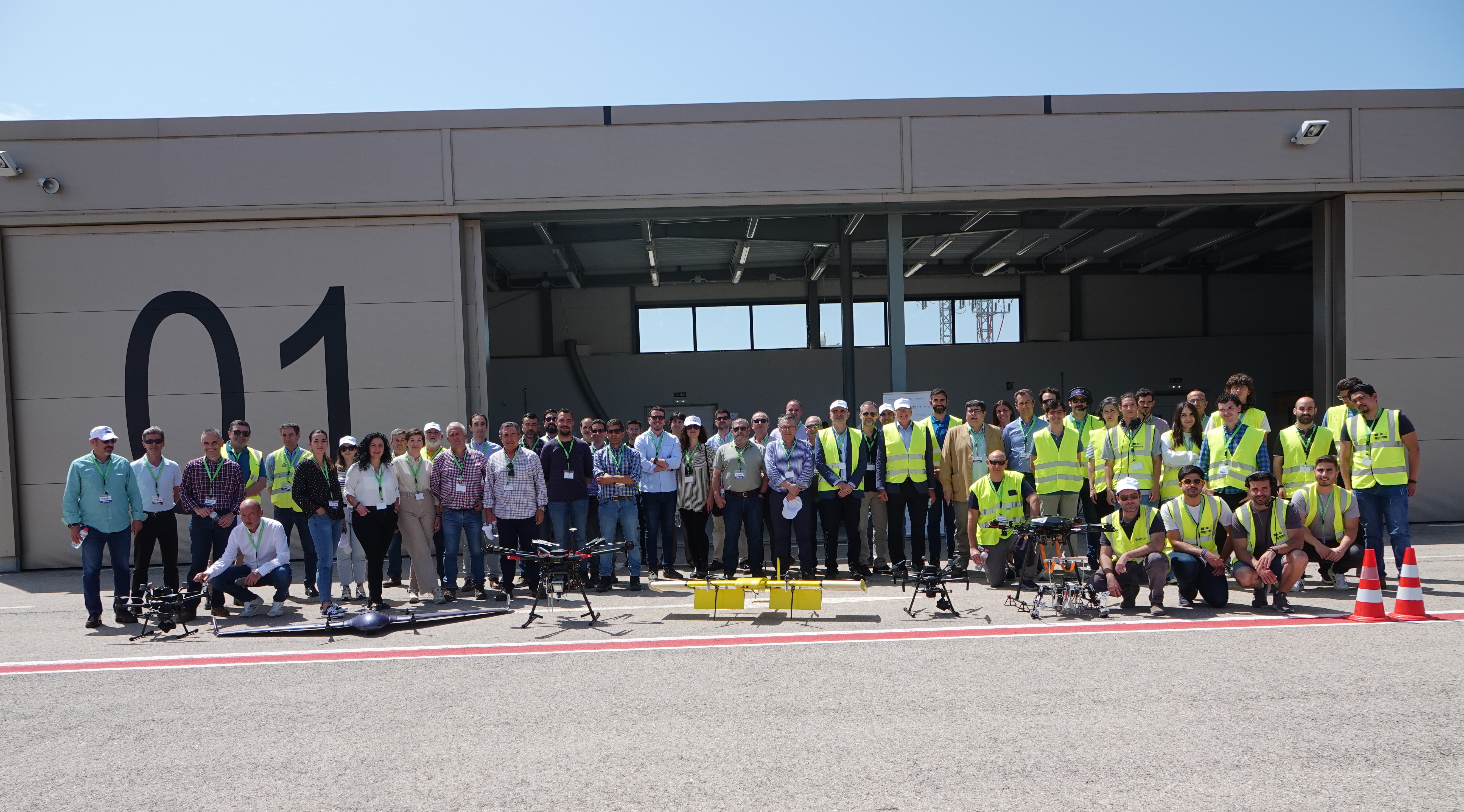
The GRVC Robotics Laboratory at the Higher Technical School of Engineering of the University of Seville, directed by Aníbal Ollero, is organizing the closing event for the AERIAL-CORE project (AERIAL COgnitive integrated multi-task Robotic system with Extended operation range and safety). After four years of research involving more than 15 international institutions, this initiative will culminate in a final review on October 26 and 27 at the ATLAS Center in Villacarrillo (Jaén). In addition to presenting the academic results, an outdoor demonstration of the robots will be conducted, including tests such as mapping, interaction between multiple devices, tool manipulation, and high-voltage line testing, among others.
AERIAL-CORE was founded in 2019 with the goal of developing an integrated, cognitive, aerial robotic system to collaborate with human operators in the inspection and maintenance of large infrastructures, reducing costs and improving workplace safety. To date, it has not only implemented this technology but has also produced over 200 academic publications and supported 20 doctoral theses. In its third and most recent phase alone, it has received 13 awards and registered 5 patents. As part of this project, workshops and presentations have been conducted at prestigious conferences such as ICRA, IROS, and ICUAS in several of their annual editions, as well as at research centers worldwide, including the Beijing Institute of Technology Virtual, the National Research Programme of Singapore, INRIA in France, KAIST in Korea, and the Gordon Research Conference Robotics and L4DC in the United States, solidifying the project's success.
More about AERIAL-CORE
With funding exceeding €8.5 million, AERIAL-CORE has been developing devices since 2019, such as aerial robots capable of inspecting infrastructure with high precision (subcentimeter accuracy) over long distances (several kilometers), among other capabilities. The project's researchers have also applied cognitive functions to the devices to combine hovering and long-term endurance for local infrastructure observations, manipulation with force interactions, and robot-human collaboration.
During these four years, AERIAL-CORE has already demonstrated advances such as autonomous monitoring of a power line, mapping of vegetation near the line, bio-inspired aerial robotic platforms, landing on conductors and manipulation for their maintenance, including the installation of clip and helical type diverters or the conductor separator, among others.
All this research, which concludes in 2023, has been carried out in a consortium coordinated by the University of Seville and also made up of the École Polytechnique Fédérale de Lausanne, the CREATE Consortium, the Andalusian Foundation for Aerospace Development (FADA), the University of Zurich, the Czech Technical University in Prague, the University of Zagreb, the Aristotle University of Thessaloniki (AUTH), Terabee Designs, FuVeX, Donecle SAS, the University of Southern Denmark (SDU), E-Distribution, Vertical Engineering Solutions and the University of Twente.


