
Presentation of two literary works at the ETSI
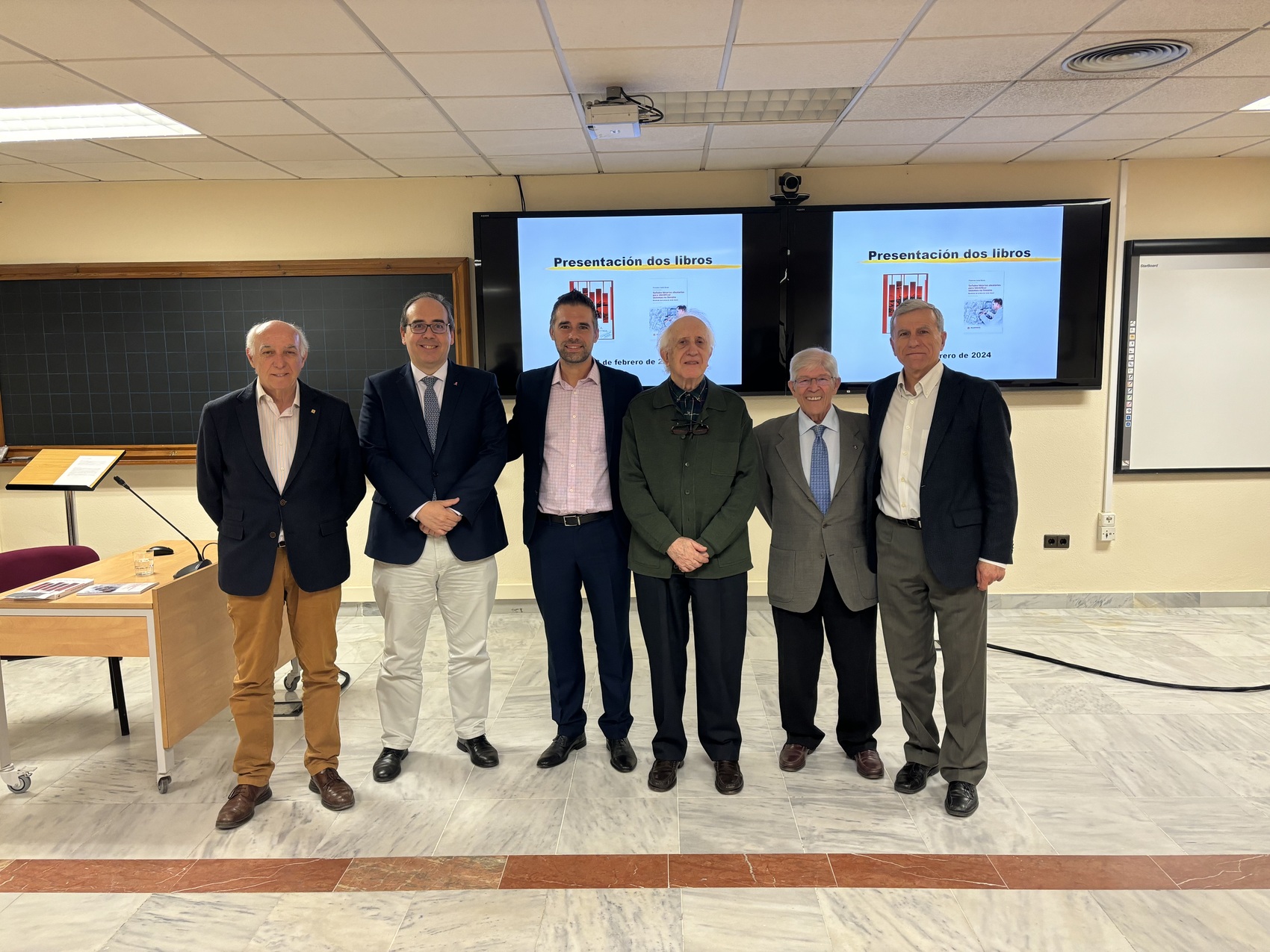
On February 8th, the official presentation of the books "Engineering: The Forging of the Artificial World. 2nd Edition," written by Professor Javier Aracil Santonja, Chair of Systems and Automation Engineering at the University of Seville, and "Random Binary Signals to Identify Nonlinear Systems. Reissue of Javier Aracil's Thesis," written by Francisco Javier Muros, was held at the Higher Technical School of Engineering of the University of Seville. The event, held in the Juan Larrañeta Room, was presided over by Andrés Sáez Pérez, Director of the Higher Technical School of Engineering of the University of Seville; Antonio Gómez Expósito, Director of the Endesa Chair; and José María Bueno Lidón, President of the Association for Industrial Research and Cooperation of Andalusia (AICIA).
Jaime Domínguez Abascal, president of the Royal Academy of Engineering, was also scheduled to attend the event, but was forced to be absent due to official matters.
Engineering: The Forging of the Artificial World
Engineering encompasses the design, construction, and operation of the components of the artificial world in which our lives unfold and without which our survival would be precarious. Despite this, it has not received the attention it deserves for its crucial role in shaping this world of inventions, made by and for humans, and based on the reshaping of nature according to utilitarian objectives that satisfy our needs and desires. In intellectual circles, the dominant tendency has been to consider it simply as an application of science, without granting it any specificity or superior status, thus reducing it to a subordinate task, even though it has a crucial influence on our society. This has ultimately produced a distorted image of engineering in the public eye. This book thoroughly challenges this perspective, seeking to restore to engineers their decisive role in the invention and manufacture of the artificial world that shelters us, and in which we achieve a life of greater well-being than in the natural world.
Javier Aracil, a member of the Royal Academy of Engineering, has written this reflection (corrected and expanded from the first edition) in which he investigates the specific and autonomous features that characterize the way engineers act, who have produced the environment populated with beneficial artifices that characterizes our species.
Random binary signals to identify nonlinear systems. Reissue of Javier Aracil's thesis.
This work presents a reissue of Professor Javier Aracil's doctoral thesis, defended in 1969, which was groundbreaking for several reasons. Firstly, it was a pioneering work in its time, being one of the first engineering theses in Spain, since the 1957 Law on the Organization of Technical Education had previously equated the Spanish engineering degree with a doctorate. Indeed, it had the distinction of being the first Industrial Engineering thesis from the Madrid School of Industrial Engineers to be defended publicly before a five-member panel, as is now standard practice.
Furthermore, the thesis has significant theoretical value, as it generalizes transfer function-based procedures, previously used only for linear systems, to nonlinear systems. To achieve this, Professor Aracil demonstrated the equivalence between random binary signals and Gaussian signals, and experimentally developed a generalized intercorrelator. Evidence of the thesis's relevance was its publication in the prestigious journal IEEE Transactions on Automatic Control, presumably the first contribution to the journal from a Spanish industrial engineering school.
These milestones speak to the interest of a thesis that broke barriers in its time, and which fully justify this reissue.


