
A snapshot of the Andalusian Aerospace Sector
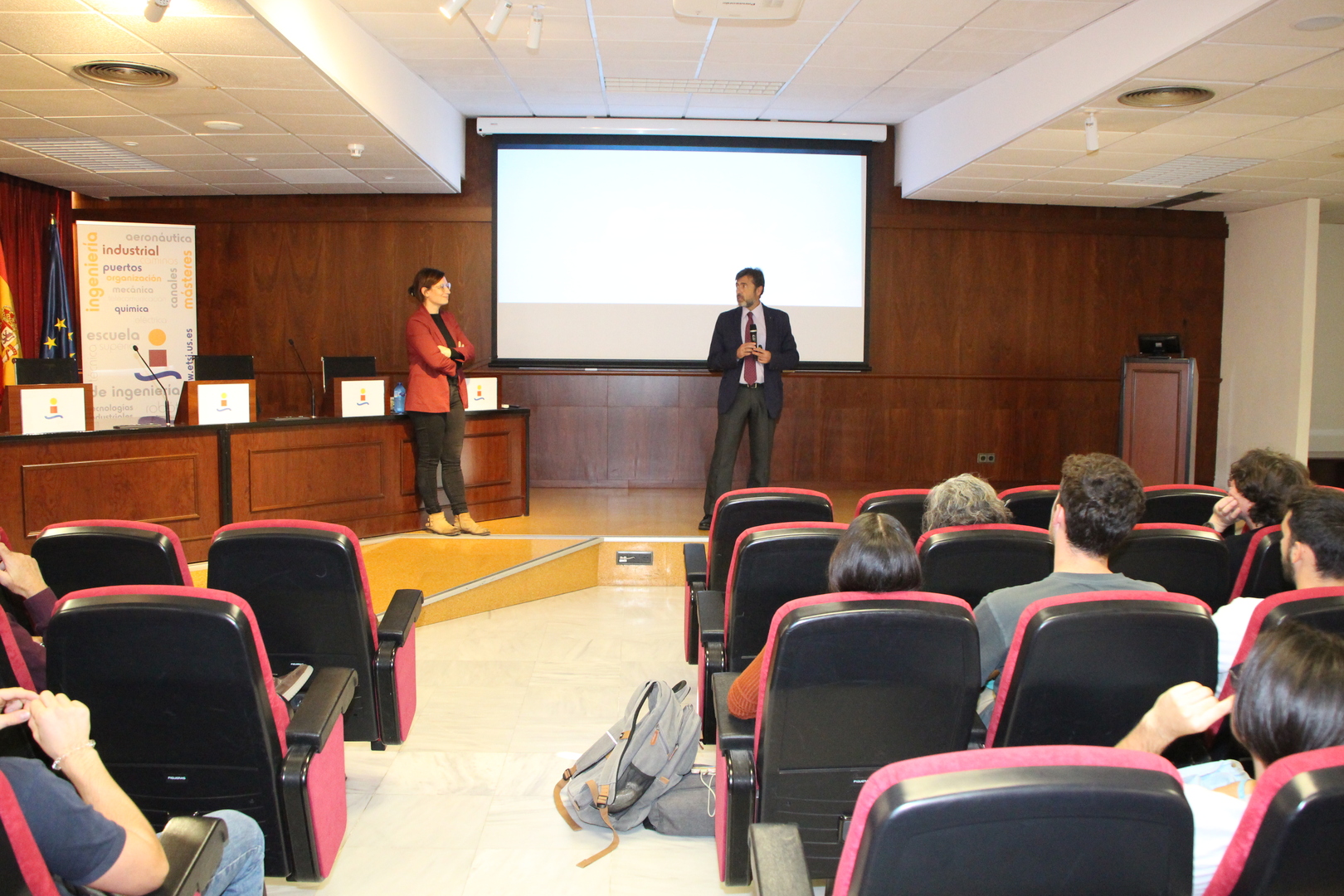
Juan Román Gallego, managing director of the Andalusia Aerospace Business Cluster, and Mélanie Durth, its innovation manager, visited the Higher Technical School of Engineering (ETSI) to provide faculty and students with data and information on the Andalusian aerospace sector and its companies, including strategies, challenges, and opportunities. At this event, organized by EUROAVIA Sevilla with the support of ETSI, they presented and detailed various topics in a talk that proved highly engaging for all attendees.
The aerospace industry in Andalusia boasts a long, century-long history, placing it among the top five aerospace regions in Europe. Its origins date back to 1927 with the establishment of a factory by the national company Construcciones Aeronáuticas SA (CASA). CASA's emergence significantly boosted the sector, leading to the design of the first Spanish aircraft. In 1999, EADS (European Aeronautic Defence and Space Company, now Airbus SE) acquired CASA, thus becoming part of the European conglomerate. The most important milestone for the region since then has been the selection of Seville as the site for the A400M Final Assembly Line (FAL). There was a pressing need to promote collaboration among companies in the area to strengthen the Andalusia brand and generate synergies and opportunities. Therefore, in 2017, the Andalusia Aerospace business cluster was created.
The Andalusian aerospace sector comprises 140 companies, of which 103 are located in Seville, 22 in Cádiz, and 11 in Málaga. In general, the Andalusian aerospace sector is characterized by small and medium-sized enterprises (SMEs); nearly 70% of the industry consists of SMEs, meaning they have fewer than 250 employees and a turnover of less than €50 million.
The sector's total revenue in 2022 exceeded €2.3 billion. The pandemic in 2020 halted the momentum of sustained growth. In 2019, revenue nearly surpassed €3 billion. However, the recovery is progressing faster than anticipated. Andalusia accounts for 39% of Spain's aerospace exports. Almost 50% of these exports go to Germany and France, the major aerospace hubs in Europe.
One of Andalusia's strengths is its infrastructure, home to three aerospace parks: Aerópolis in Seville, the Bay of Cádiz Center, and the Andalusia Technology Park in Málaga. Also noteworthy is the FADA-CATEC technology center, a leading center for the Andalusian sector. Other key infrastructure includes the ATLAS experimental flight center in Jaén and the future CEUS in Huelva, slated for completion next year, which will be the largest drone testing and experimentation center in Europe.
Key institutional support includes TRADE, a public company of the Andalusian Regional Government that promotes the internationalization of Andalusian businesses and attracts foreign investment; and Invest in Andalusia, an initiative of the Andalusian Government to promote, attract, and consolidate foreign investment in the region. The support of universities is fundamental, both in terms of research projects and doctoral programs, and in raising students' awareness of the sector.
The sector's strength lies in its privileged location, with powerful companies not only in Andalusia but also in nearby regions such as Portugal, Morocco, and other parts of Spain. Furthermore, Seville's selection as the headquarters of the Spanish Space Agency enhances the attractiveness of locating space companies in the region.
The Andalusia Aerospace cluster comprises over 90 companies, fostering cooperation among them, promoting the growth of the aerospace sector in our region at both national and international levels, and increasing the competitiveness of companies through sustainable technological development. To this end, meetings and conferences are held among the companies, the Andalusia Aerospace brand is promoted worldwide through participation in international trade fairs, and companies' involvement in R&D&I projects is encouraged.
The Andalusian region, in addition to the three Airbus aircraft assembly plants in Seville and Cadiz, has pilot training schools such as Pegasus Aero Group in Cordoba or FTEJerez in Jerez de la Frontera, as well as an MRO (Maintenance, Repair and Overhaul) market such as Ryanair's maintenance center in Seville, where its aircraft from southern Europe are repaired.
It is important to keep an eye on the sector's new driving programs. The two main European projects currently underway are FCAS (Future Combat Air System) and Eurodrone, both with Spanish participation. Andalusian industry is well-positioned to participate in these programs.
Following the speakers' presentations, a question and answer session was opened. These focused primarily on potential synergies between businesses and universities, with the aim of improving student training.


