
The 4th JoinUS Challenge rewards the talent of Seville students with innovative proposals aligned with the SDGs
The 4th JoinUS Challenge rewards the talent of Seville students with innovative proposals aligned with the SDGs
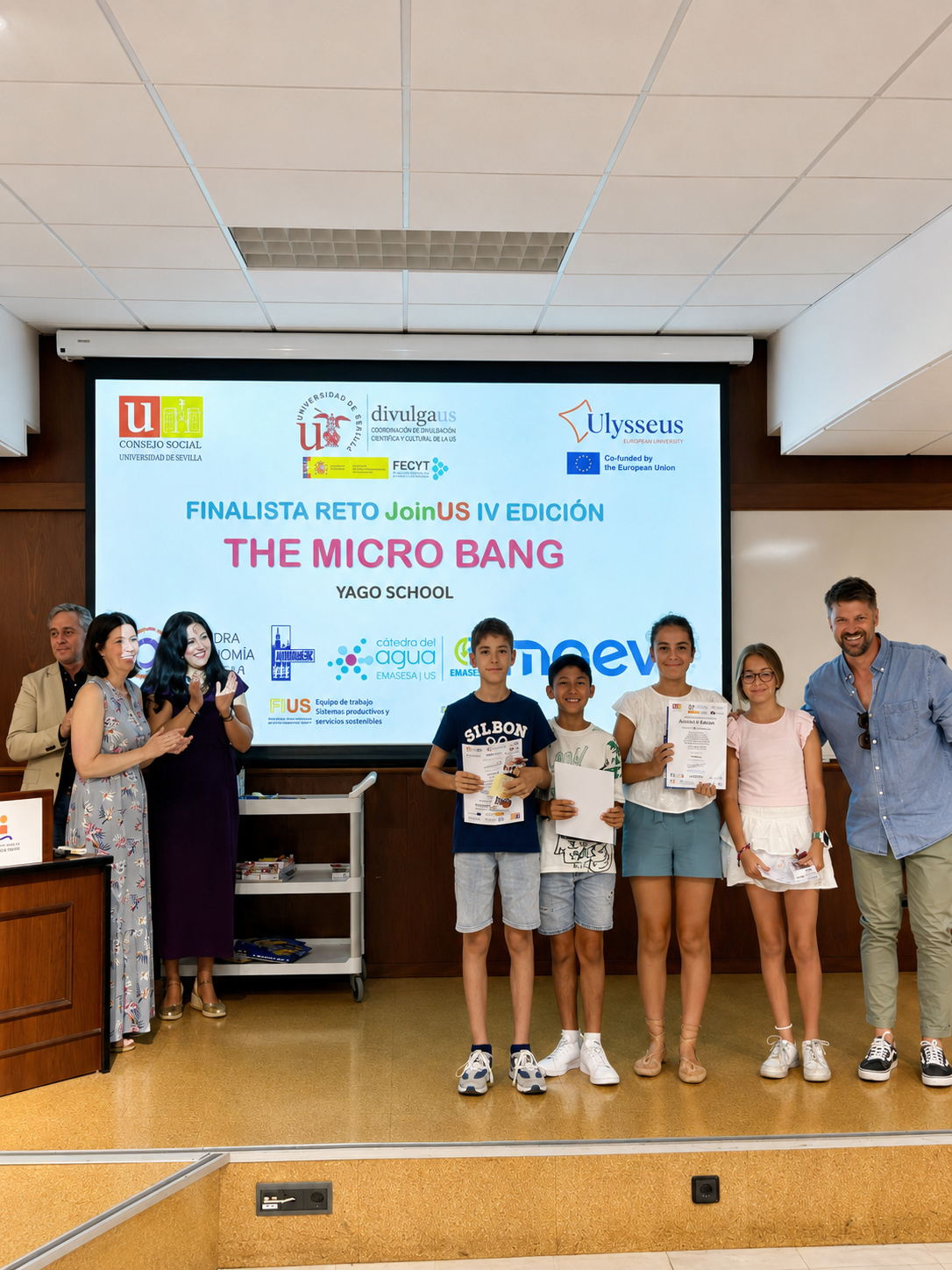
The Higher Technical School of Engineering (ETSI) of the University of Seville hosted the awards ceremony for the 4th JoinUS Challenge on June 18th, corresponding to the 2025/2026 academic year. The event brought together students, teachers, families, institutional representatives and collaborating entities to recognize the work carried out by the nearly 30 participating teams from educational centers throughout the province of Seville.
In this edition, primary and secondary school students presented innovative proposals aimed at addressing social and environmental challenges linked to the Sustainable Development Goals (SDGs) of the 2030 Agenda. The projects, presented in audiovisual format, stood out for their creativity, analytical skills, and commitment to building a more sustainable future.
Teams from schools such as IES Lauretum, Colegio Pontífice Pablo VI, IES Leonardo da Vinci, Colegio Buen Pastor, Yago School, St. Mary's School, and IES Mateo Alemán participated. As part of the challenge, the students had to first complete a questionnaire based on scientific research currently being conducted at the University of Seville and disseminated through videos available on the JoinUS platform.
After evaluating the submitted projects, the jury awarded first prize to the Raíces Unidas team from the Pontífice Pablo VI School, which received a cash prize of 500 euros to be used for school materials or activities. Additionally, due to the high quality of the finalist proposals and the close evaluation process, a Special Mention was awarded to the Guardianes del Futuro 4.0 team from the Buen Pastor School, which received a prize of 250 euros.
In addition to the main prizes, all semi-finalist and finalist teams received personalized scientific calculators featuring the image of mathematics communicator Clara Grima, as well as copies of the magazine Jot Down Kids and various gifts from the University of Seville and the ETSI intended for both students and teachers and the participating centers.
The ceremony was presided over by Carmen Hernández Mancera, Deputy Director of Students at ETSI, accompanied by María del Rosario Martínez Navarro, Director of the Secretariat for Scientific and Cultural Dissemination; Rocío Martínez de Pablos, Director of the Secretariat of the University of Seville; Manuel Jesús Soto Prieto, Director of the Secretariat for International Strategy; and Manuel Jesús Sabariego Gómez, Academic Director of the European University Ulysseus.
The event was also attended by representatives of the collaborating entities that contributed to the funding of the awards. Benito Navarrete Rubia represented the Moeve Chair, while the Aborgase Chair was represented by José Caraballo, the company's CEO; Carmen García, an environmental technician; and Judith González Arias, a researcher at the University of Seville.
The 4th JoinUS Challenge was made possible thanks to the support of the Scientific Outreach Secretariat of the University of Seville, the Ulysseus European university alliance, and the Social Council of the University of Seville. The Aborgase, Moeve, and EMASESA corporate chairs, the FIUS Sustainable Production Systems and Services working group, and the journal [publication name missing] also collaborated in providing the prizes and developing the initiative Jot DownFabLab Sevilla and the Higher Technical School of Engineering itself.
Bringing university research closer to the classroom
JoinUS was created to inspire scientific vocations among primary and secondary school students by bringing the research conducted at the University of Seville to educational institutions. Through this initiative, researchers from various fields of knowledge demonstrate, using audiovisual resources, how their work contributes to addressing some of the major challenges facing society today.
With four editions held, the project continues to consolidate itself as a benchmark in scientific dissemination and in the promotion of research culture among young people, fostering critical thinking, creativity and commitment to sustainable development.


