
VANTUS AeroDesign ranks among the top 20 in the world in the Air Cargo Challenge 2026
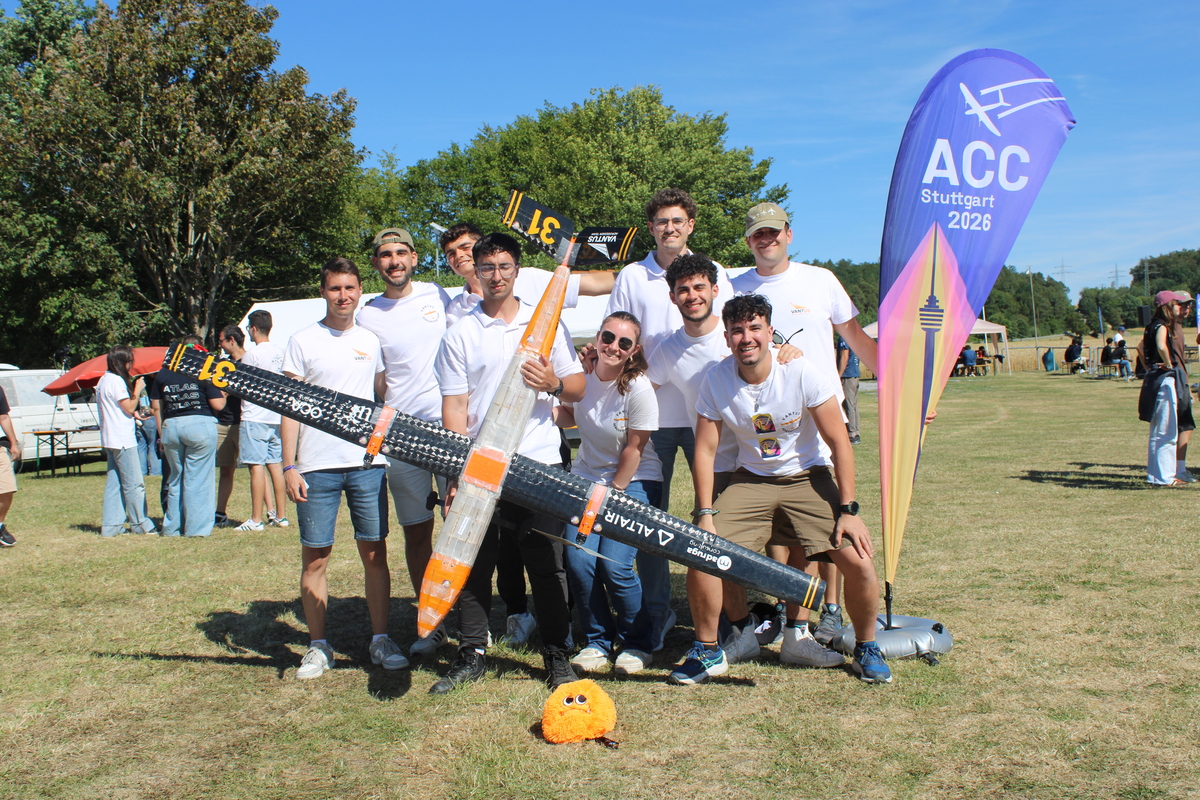
The VANTUS AeroDesign team (Unmanned Aerial Vehicles of the University of Seville) has successfully completed its participation in the Air Cargo Challenge (ACC) 2026, held in Stuttgart, Germany, from June 30 to July 3. The Seville-based team secured 18th place overall—placing them within the world's Top 20—and was named the second-best Spanish team in the most demanding university aeromodelling competition on the international scene.
This year's ACC has broken historical attendance records, bringing together teams from universities in Europe, Asia, America and Oceania, with delegations from technological powers such as the United States, Australia, Thailand, Germany and France.
A competition of the highest technical demands
This year's challenge centered on a rigorous speed and payload test: aircraft had to complete a closed circuit within a two-minute time limit, maximizing the distance covered while carrying as many commercial soda cans as possible as cargo. The rules also penalized or rewarded the accuracy of design predictions and the teams' agility in loading and unloading on the ground.
After a design phase in which VANTUS developed and evaluated two different aerodynamic configurations — one optimized for high speed with slender, high-aspect-ratio wings, and another focused on the mass transport of cargo — the team opted for the first variant for the debut of its new prototype, named Trajanus.
Resilience in the face of adversity
The road to success was not without its challenges. At the start of the event, logistical problems beyond the organization's control led to the prototypes being lost at Amsterdam Airport, delaying the mandatory technical inspection. Once the equipment was recovered against the clock and passed the inspection, the team faced technical failures in the first two flight attempts. These were caused by an accidental displacement of electronic components inside the fuselage, which altered the center of gravity, followed by a landing gear failure.
Demonstrating critical reaction and decision-making capabilities under pressure, the 10 team members deployed to Stuttgart—supported by the availability of previously manufactured structural spare parts—completely repaired the aircraft. In subsequent flight sessions, Trajanus executed clean takeoffs in just 20 meters and highly stable flights, steadily increasing its score round after round and successfully carrying up to 5 cargo cans over a cumulative distance of 2.5 km in changing weather conditions.
The team was led by its director, Paula Terrón, and the technical director, Gonzalo Collado—responsible for presenting the design to the jury at the University of Stuttgart. The technical delegation also included Agustín Castro (pilot), Álvaro Carmona (Flight Dynamics), Carlos Martínez (Structures), Alejandro Luis Rabanal and Álvaro García (Systems), Alejandro Martín and Teresa Porras (Aerodynamics and Stability), and Juan Antonio Díaz (Treasurer). They also received institutional support and pit crew assistance from Sergio Esteban (Deputy Director of Innovation) and Carmen Hernández (Deputy Director of Students) from the Higher Technical School of Engineering (ETSI) at the University of Seville.
Second place in extraordinary exhibition flight
The grand finale of the competition came with the extraordinary speed test organized in Stuttgart: a timed sprint of 10 laps of 100 meters in the shortest possible time.
At the controls of pilot Agustín Castro, the Trajanus prototype showcased its true aerodynamic potential, stopping the clock at a spectacular 54 seconds and positioning itself as the second fastest aircraft in the international competition. This achievement allowed VANTUS to surpass the other European teams and equal the record set by the Valencian team Xtra2 (UPV), placing Spanish university aeronautical engineering at the forefront of student aeromodelling worldwide.
With this result in its fourth season, VANTUS AeroDesign confirms the significant growth of the discipline in Seville and lays the groundwork for future competitions, demonstrating that Andalusian talent, scientific rigor, and resilience know no bounds in the aerospace sector. The team will continue designing, creating, and flying, as it has proven it can do so far


