The VANTUS aeromodelling team debuts a new model in the international Air Cargo Challenge 2024 competition
The VANTUS aeromodelling team debuts a new model in the international Air Cargo Challenge 2024 competition
CIRIO I successfully passed the technical tests and achieved a successful flight
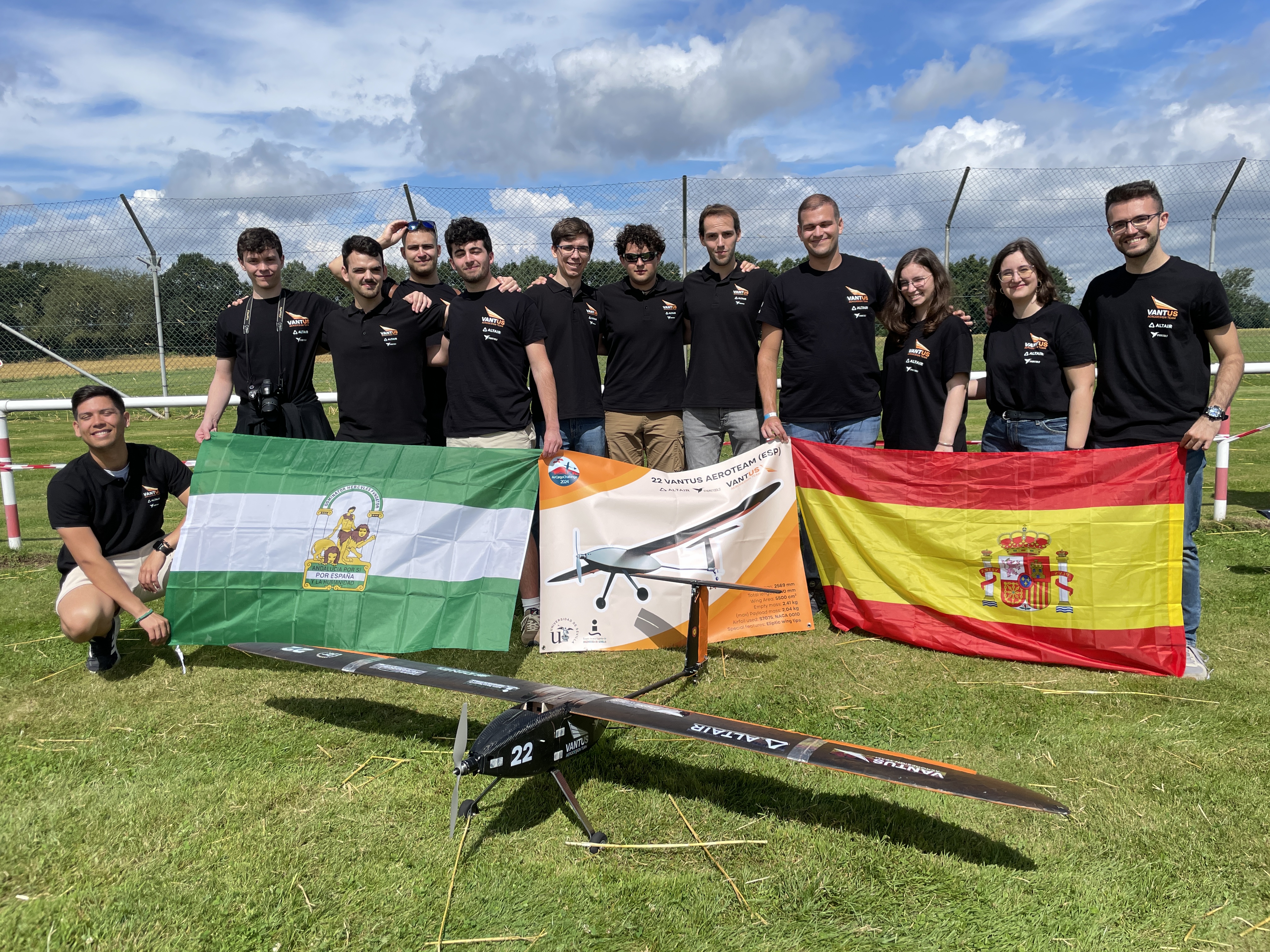
The VANTUS AeroDesign Team, a student aeromodelling team from the University of Seville, formed at the Higher Technical School of Engineering during the 2021-22 academic year, presented its new model, CIRIO I, a fixed-wing cargo drone designed and built entirely by the team members. This new model took them to the Air Cargo Challenge 2024 competition, held in Aachen, Germany, from July 9th to 13th.
This competition represents a huge technical leap for the team compared to the previous edition, XtraChallenge 2023, held in Valencia. “It’s a paradigm shift in the magnitude and impact of the VANTUS project, as the team will be competing against universities not only from Europe but from the rest of the world, including teams from China, the USA, and India, which have a long track record,” explains Emilio Chacón Revilla, Team Leader.
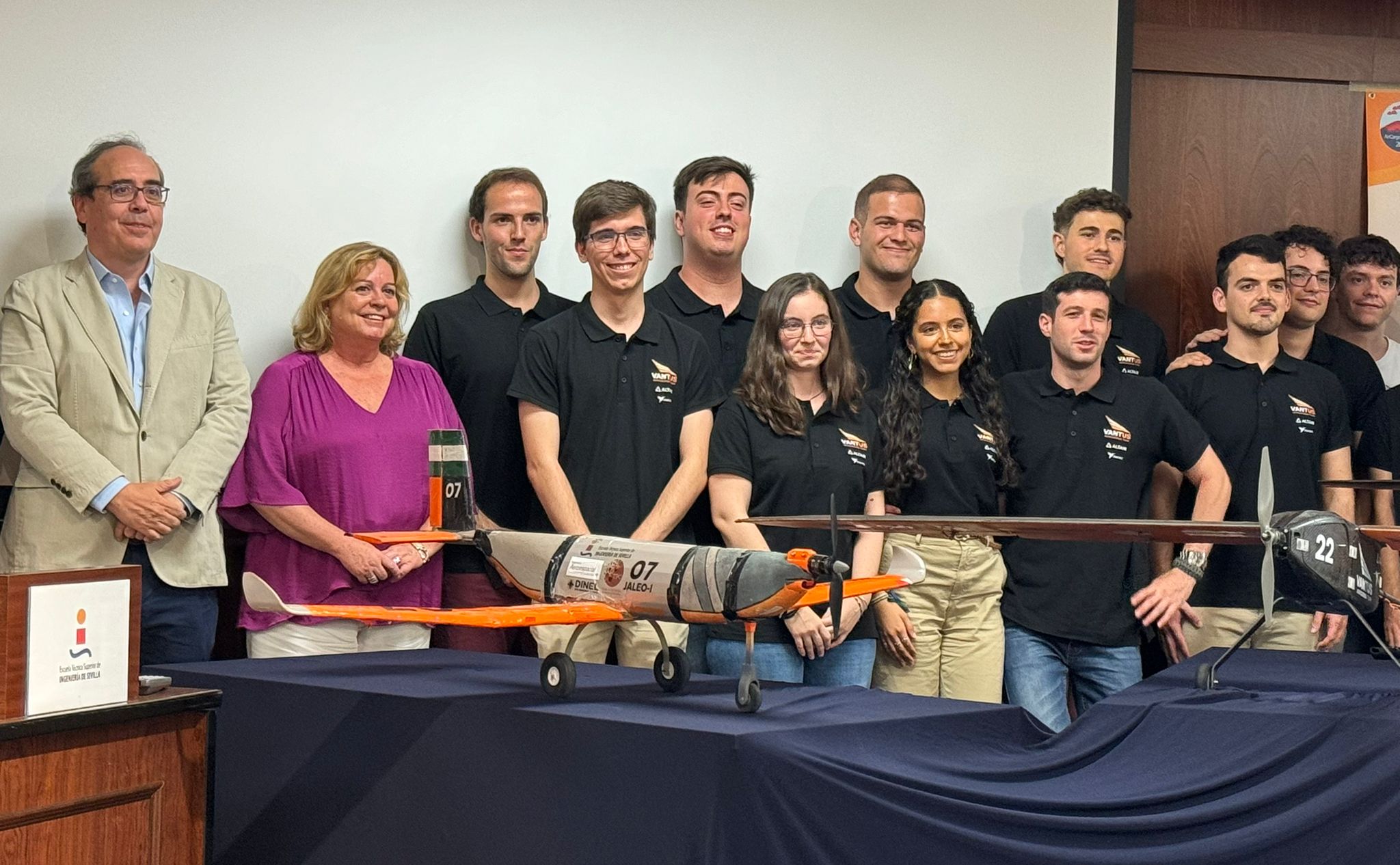
The presentation of CIRIO I was attended by Carmen Gallardo Cruz, Vice-Rector for Students of the University of Seville, Andrés Sáez Pérez, Director of the Higher Technical School of Engineering of the University of Seville and Sergio Esteban Roncero, Delegate of the Rector for the Promotion of Technological Transfer in Teaching Innovation, as well as the members of VANTUS AeroDesign Team, which is currently made up of almost 40 engineering students from the University of Seville.
This student association from the University of Seville participated last year in the championship organized by the Polytechnic University of Valencia with a completely original aircraft design, the JALEO I, named in honor of the Andalusian writer Federico García Lorca. They finished sixth overall and also won two prizes. This year, they have named their design CIRIO I, inspired by the region where it originated, as the candle is a prominent and significant element in many Andalusian festivals and traditions.
The Air Cargo Challenge marks the team's first international competition, where the new CIRIO I model has competed against teams from universities across Europe and around the world. With this new version, improved in both technical and aerodynamic aspects, they aim to surpass their performance from the previous edition, as well as learn from and enjoy the student and academic atmosphere that comes with participating in competitions of this kind, which offer the opportunity to meet other students with similar interests and concerns.
VANTUS at the Air Cargo Challenge
In the Air Cargo Challenge, the first challenge the VANTUS team faced was the technical inspection of their CIRIO I aircraft. It had to meet rigorous safety standards to be able to fly without compromising the integrity of the event. After more than 30 minutes of preparation, during which they meticulously checked every detail, they successfully passed the inspection. The aircraft was ready to compete without risk.
On the afternoon of the first day, they conducted their first test flight. Although this round didn't count towards the score, it was crucial for the pilot to become familiar with the aircraft's controls. However, a sharp turn ended in an accident, and the plane crashed to the ground. The team set to work repairing it and getting it ready for the next day.
The second day was an even greater challenge. After a night of intense repairs, they managed to get the CIRIO I ready in just 16 hours. However, they had to undergo another inspection before flying again. The pressure was high, but their determination and effort kept them in the competition.
During the third and final day of competition, the weather conditions worsened considerably. Heavy rain and winds forced the delay of some flights and affected the overall progress of the event. Despite these challenges, the VANTUS team managed to complete a successful flight, thus finishing all the competition rounds. Eventually, the entire round was completed, and the competition came to an end.
The following night, the final results were shared. VANTUS placed 15th out of 30 teams, an excellent position since they not only finished above half of the participating teams, but also positioned themselves as the second-best Spanish team, surpassed only by the aircraft built at the Polytechnic University of Valencia.
The pilot's skill, the high level of technical expertise, and the team's cooperation all contributed to this achievement. It is important to note that, despite this being their first international competition and being only two years old, VANTUS has established itself as one of the best university aeromodelling teams in Spain.
Chacón Revilla expressed his gratitude at the event for the collaboration of the University of Seville and, in particular, its Higher Technical School of Engineering, stating that “together with the effort and work of the team members, they are responsible for VANTUS being able to attend the Air Cargo Challenge 2024 with a model like CIRIO I. Thanks to their continued support, we have been able to compete at the same level as some of the most prestigious universities in the world.”.
A young team with a long future ahead
The VANTUS team, an acronym for Unmanned Aerial Vehicle of the University of Seville, is a university organization based at the Higher Technical School of Engineering of Seville, made up of a group of students with the aim of participating in international aeromodelling competitions by designing, building and flying light radio-controlled aircraft or RPAS.
VANTUS emerged in response to a need identified by students in the Bachelor's and Master's programs in Aeronautical Engineering at the Higher Technical School of Engineering of the University of Seville. The School boasts numerous research projects led by faculty, in which students participate to develop their final degree and master's theses, as well as other motorsports-focused competition teams, such as USRacing and ARUS. However, despite these opportunities, the vast majority of aerospace engineering students had few chances to put their knowledge of aircraft design, aerodynamics, flight mechanics, and other disciplines intrinsic to the aeronautical field into practice. Furthermore, opportunities to physically and directly observe the complete engineering process behind the aircraft about which they receive so much theoretical training are infrequent.
VANTUS has allowed these students to take on a new challenge, those who wish to be involved in a project parallel to their studies, and are looking for a way to put into practice the high theoretical load of the training provided by the ETSi, as well as pour all their ambition, motivation and creativity into an exciting goal such as creating their own competition aircraft.
Air Cargo Challenge
The Air Cargo Challenge (ACC) was originally launched by the APAE (Portuguese Association of Aeronautics and Space) in 2003, inspired by North American university competitions (Design-Build-Fly). Since then, the competition has been held every two years. Starting in 2007, it was opened to participation not only from European universities but also from other countries around the world.
Competitors must design and manufacture an aircraft capable of lifting the greatest possible weight. In addition, the aircraft must be able to take off in less than 61 meters, circle the airfield at least once, and land safely.
This competition offers students and university members the opportunity to design, build and fly a radio-controlled aircraft to compete with teams from different European universities.
The winning team is responsible for organizing the next edition at their headquarters, giving them the opportunity to put on a major event. Each edition has its own rules; however, the core of the competition remains the same: to raise the highest possible payload.
The competition is divided into two main sections: static tests and flight tests. The static tests consist of submitting a project report, blueprints, and a presentation, while the flight tests involve flying the aircraft around a circuit and landing it safely. In this section, the quality of the landing and the speed at which the circuit is completed are also important.