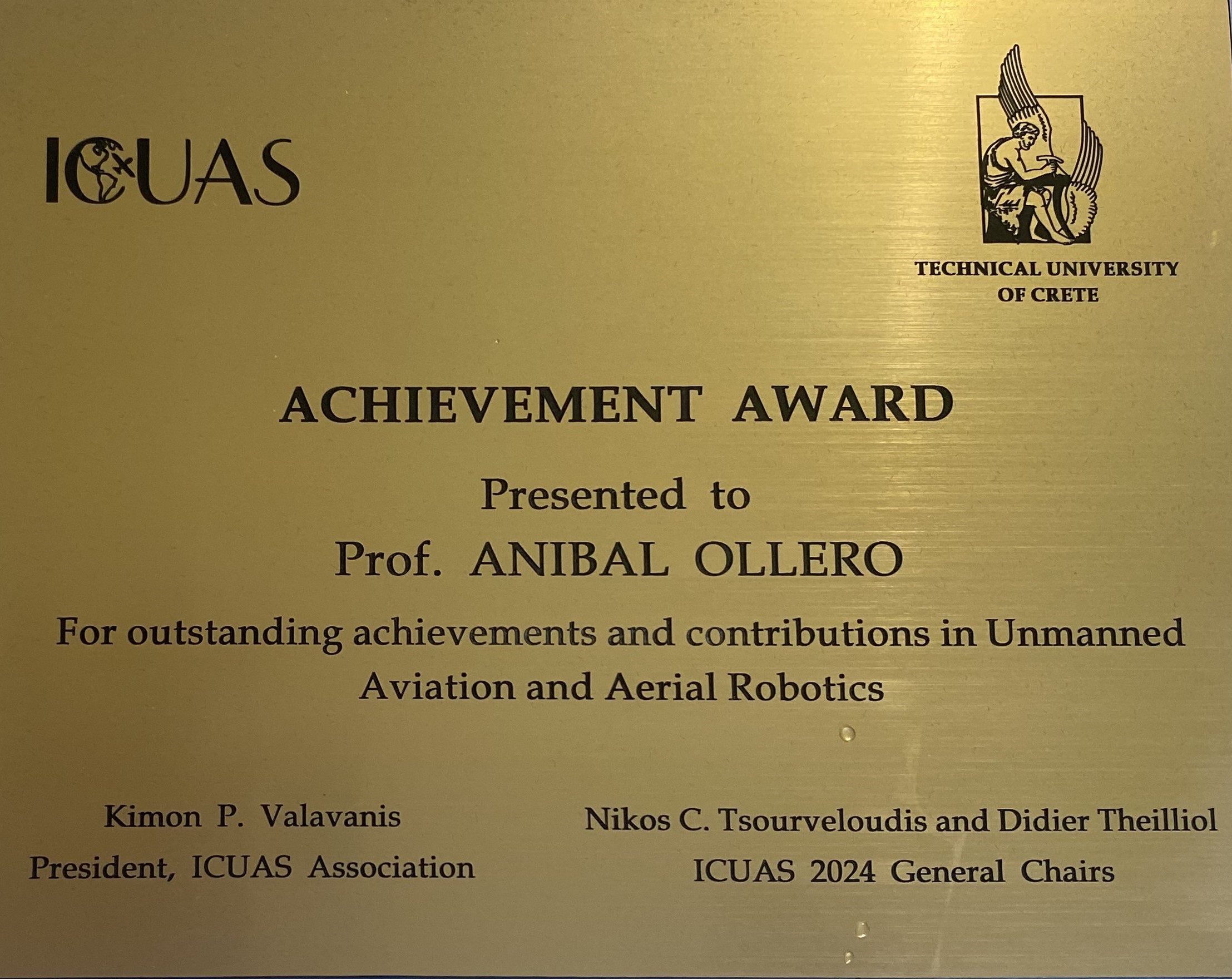
Professor Aníbal Ollero receives the ICUAS Achievement Award 2024
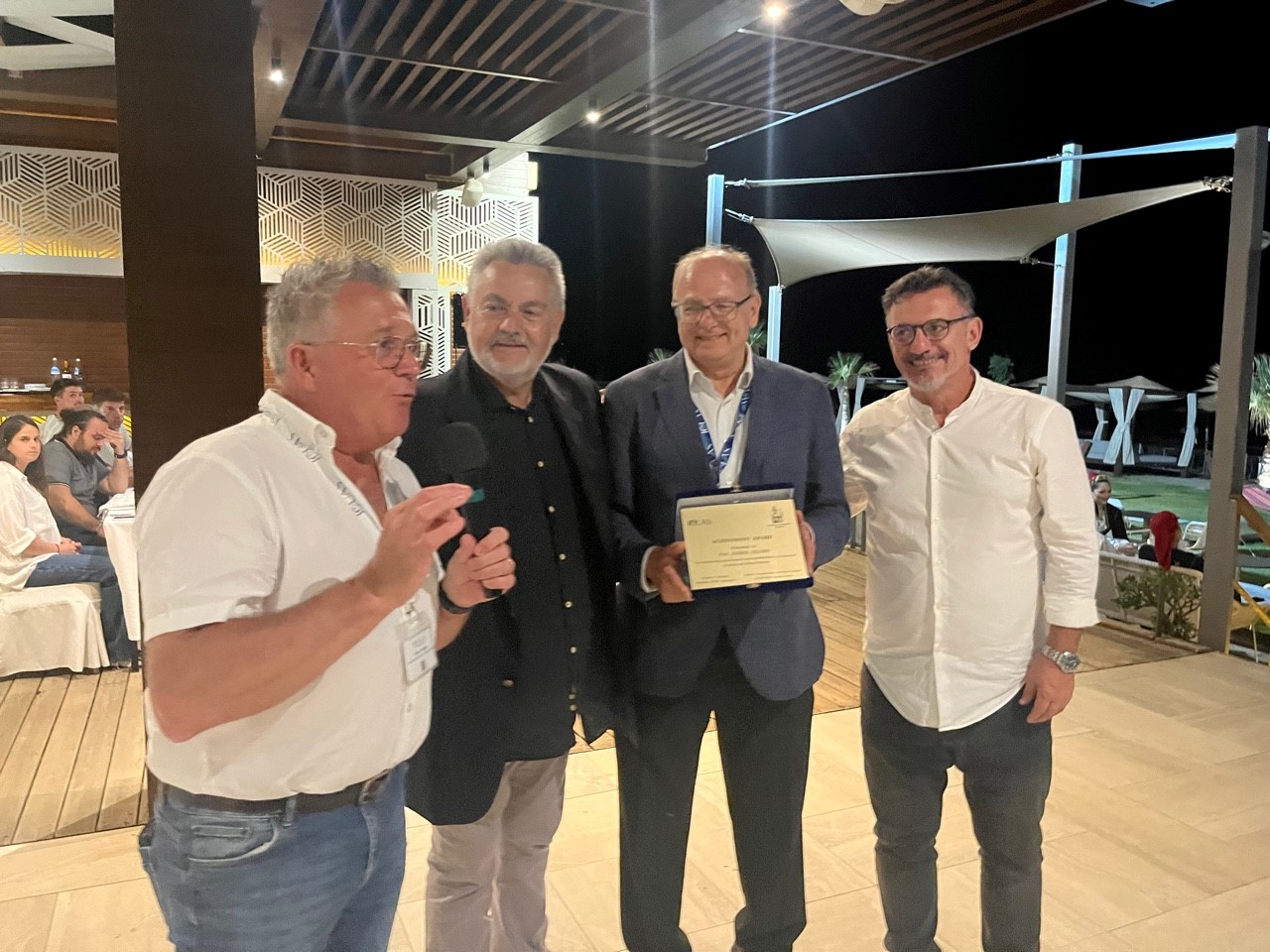
Aníbal Ollero Baturone, director of the Robotics, Vision and Control Group (GRVC) and professor at the Higher Technical School of Engineering of the University of Seville, has received the 2024 ICUAS Achievement Award, becoming the first recipient of this recognition. The organization wished to honor Professor Ollero's decades of work and "outstanding achievements and contributions in unmanned aviation and aerial robotics." Professor Ollero also served as honorary president of this year's awards ceremony, held from June 4 to 7 in Chania, Crete, Greece.
The GRVC director received the award from Kimon Valavanis, from the University of Denver, president of the ICUAS Association, and from the ICUAS 2024 general presidents, Nikos Tsourveloudis and Didier Theilliol, members of the Technical University of Crete and the University of Lorraine respectively, in a ceremony held on June 6 in the Hellenic city and which has been attended by the main references in the development and research of aerial robotics worldwide.
Professor Aníbal Ollero, who is also the Scientific Director of the Advanced Center for Aerospace Technologies (CATEC) in Seville, counts among his achievements being the author with the most publications on UAVs, aerial robotics and aerial manipulators according to Scopus and has directed more than 190 research projects, 45 of which are international, more than fifty doctoral theses and is a member of the Royal Academy of Engineering of Spain, the Royal Academy of Sciences of Galicia and Doctor Honoris Causa by the University of Malaga.
About ICUAS 2024
The International Conference on Unmanned Aircraft Systems (ICUAS) is the world's leading conference on research into unmanned aerial systems. Held annually since 2008, its aim is to bring together the most advanced researchers and the latest work on this type of specialized robotics. This year's edition focused on the civilian and public domain uses, as well as the social impact, of unmanned aviation and its effect on the quality of daily life.
This year's workshops and conferences focused on five main areas: bio-inspired aerial platforms, hybrid platforms, robust prototype design, human factors considerations, and the framework and regulations for integrating these devices into national airspace. ICUAS 2024 brought together national and international organizations, official bodies, industry stakeholders, private sector representatives, public authorities, potential users and professionals, as well as researchers who were able to showcase their work to the world. This included the Robotics, Vision and Control Group and the eight academic papers presented during this edition, representing various research projects carried out this year.