


Curriculum
Extinction process of the Degree in Industrial Technology Engineering (2010 plan)
Starting in the 2024/25 academic year, the 2024 curriculum for the Bachelor's Degree in Industrial Technology Engineering, taught at the ETSi, will be implemented. The phase-out schedule for the 2010 curriculum is presented below.
academic year 2024/25:
| It is being implemented (2024 plan) | It is being phased out (2010 plan) |
| First GITI | First GITI |
| Second GITI | Second GITI |
| Third GITI | Third year GITI (except for subjects corresponding to the specific mention that do not have an equivalent in the new plan) |
academic year 2025/26:
| It is being implemented (2024 plan) | It is being phased out (2010 plan) |
| - | Third GITI (subjects corresponding to the specific mention that do not have an equivalent in the new plan) |
| Fourth GITI | Fourth year GITI (except for subjects corresponding to the specific mention that do not have an equivalent in the new plan) |
academic year 2026/27 (see registration guide):
| It is being implemented (2024 plan) | It is being phased out (2010 plan) |
| - | Fourth GITI (subjects corresponding to the specific mention that do not have an equivalent in the new plan)
|
You can check the last course in which you can enroll for each pending subject of the GITI-2010 at this link.
Study plan for the Bachelor's Degree in Industrial Technology Engineering (2010 plan, being phased out)
The Bachelor's Degree in Industrial Technology Engineering (2010 plan) taught at ETSi has nine mentions (also known as intensifications or specializations):
1. Mechanical Engineering - Machinery
2. Mechanical Engineering - Construction
3. Materials
4. Industrial Chemistry
5. Energy Engineering
6. Electrical
7. Electronics Engineering
8. Automation Engineering
9. Organization and Production Engineering
The name of the specialization is specifically indicated in the student's academic record, as well as in the European Diploma Supplement (EDS).
When registering online, the computer system displays all elective courses, regardless of whether they are part of the student's chosen specialization. Therefore, it is the student's responsibility to make the correct selection.
Specifically, completing one of the specializations is a prerequisite for obtaining the degree under the 2010 curriculum for all students who were not enrolled in their third year during the 2012/2013 academic year. Therefore, if a student mistakenly or intentionally completes the 240 credits by combining courses from different specializations, they will not be eligible to receive the degree and will have to take additional courses to complete one of the specializations.
Students coming from the now-discontinued Industrial Engineering program, or who were already in their third or fourth year during the 2012/2013 academic year, are exempt from this requirement. A specialization of "without specialization" is defined for them. The requirements that all students must follow, including those who may combine specializations, are specified at the end of this guide.
Therefore, it is strongly recommended that you carefully read the following guide before registering for third or fourth year subjects.
Any questions that may arise regarding this document can be submitted via email to jefaturaestudios-etsi@us.es or to docencia-etsi@us.es .
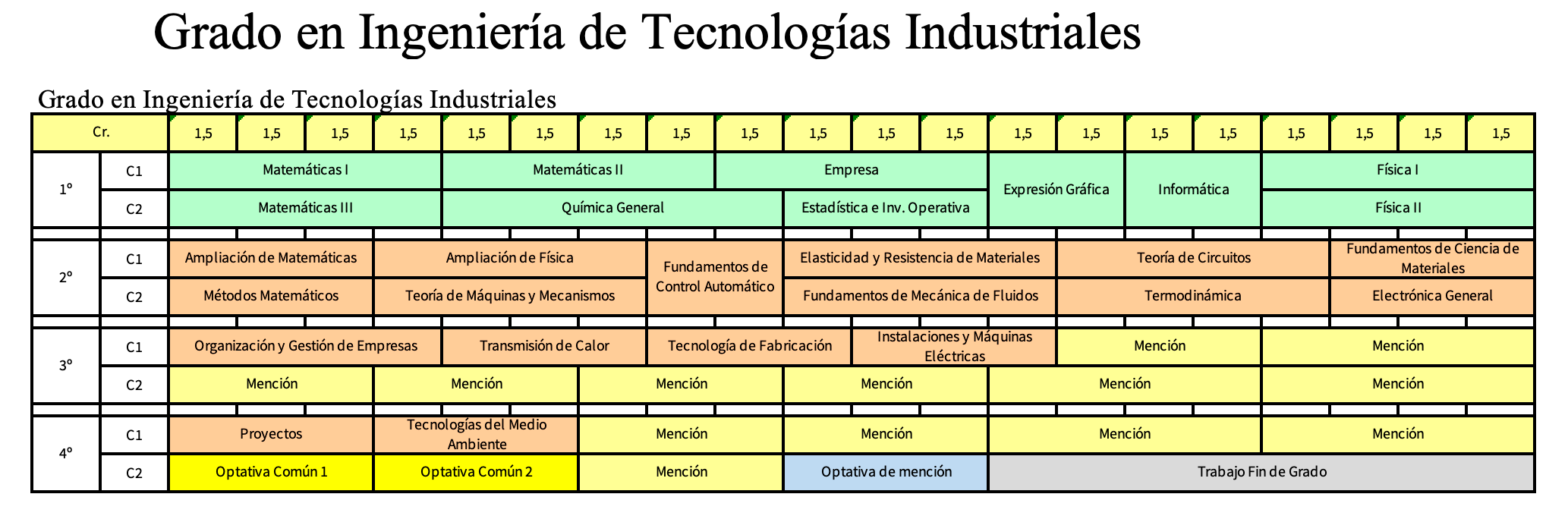
The following table shows the general structure of the studies. It shows four types of subjects, each color-coded:
The subjects indicated in aqua green in the table (identified with the specific name of each subject) are basic training subjects that all students must take.
The subjects indicated in sienna background in the table (identified with the specific name of each subject) are compulsory subjects that all students must take.
The subjects highlighted in light yellow (Specialization) are the subjects for each specialization. Once a specialization is chosen, the subjects are unique and can therefore be considered "specialization-required." These subjects are listed on the following pages for each specialization. Some of these subjects are common to several specializations. The subject highlighted in grayish-blue (Specialization Elective) is a 4.5-credit subject for which each student can choose from a selection that depends on the chosen specialization. In some specializations, no electives are offered, so this subject is replaced by a specialization-required course. In others, the selection has been reduced over the years, leaving only one subject in this category, which effectively becomes a specialization-required course.
Subjects marked in bright yellow (Common Electives): the student may take one or more of the following options regardless of the chosen specialization (9 credits in total):
Common electives for the Center or specific common electives.
Work placements. These can be taken as a 9 ECTS credit course. Students must ensure they have been assigned a company before enrolling. To do so, they should contact the ETSi's international relations office.
Subject without teaching “English in Engineering”: recognition of 4.5 credits to the student who requests it and proves a level equivalent to B2 in English.
Academic recognition for extracurricular activities (cultural, sports, student representation, solidarity, and cooperation) up to a maximum of 6 credits, in accordance with university regulations. Download PDF
Excess of unrecognized credits in other subjects for those students from the defunct Industrial Engineering degree of the University of Seville (plan 98).
The Final Degree Project is worth 12 credits. It can only be submitted and assessed once the student has passed at least 70% of the total credits for the degree.
It is also noted that the required level of language skills to obtain this qualification is B1 in English, and other languages are not valid.


