
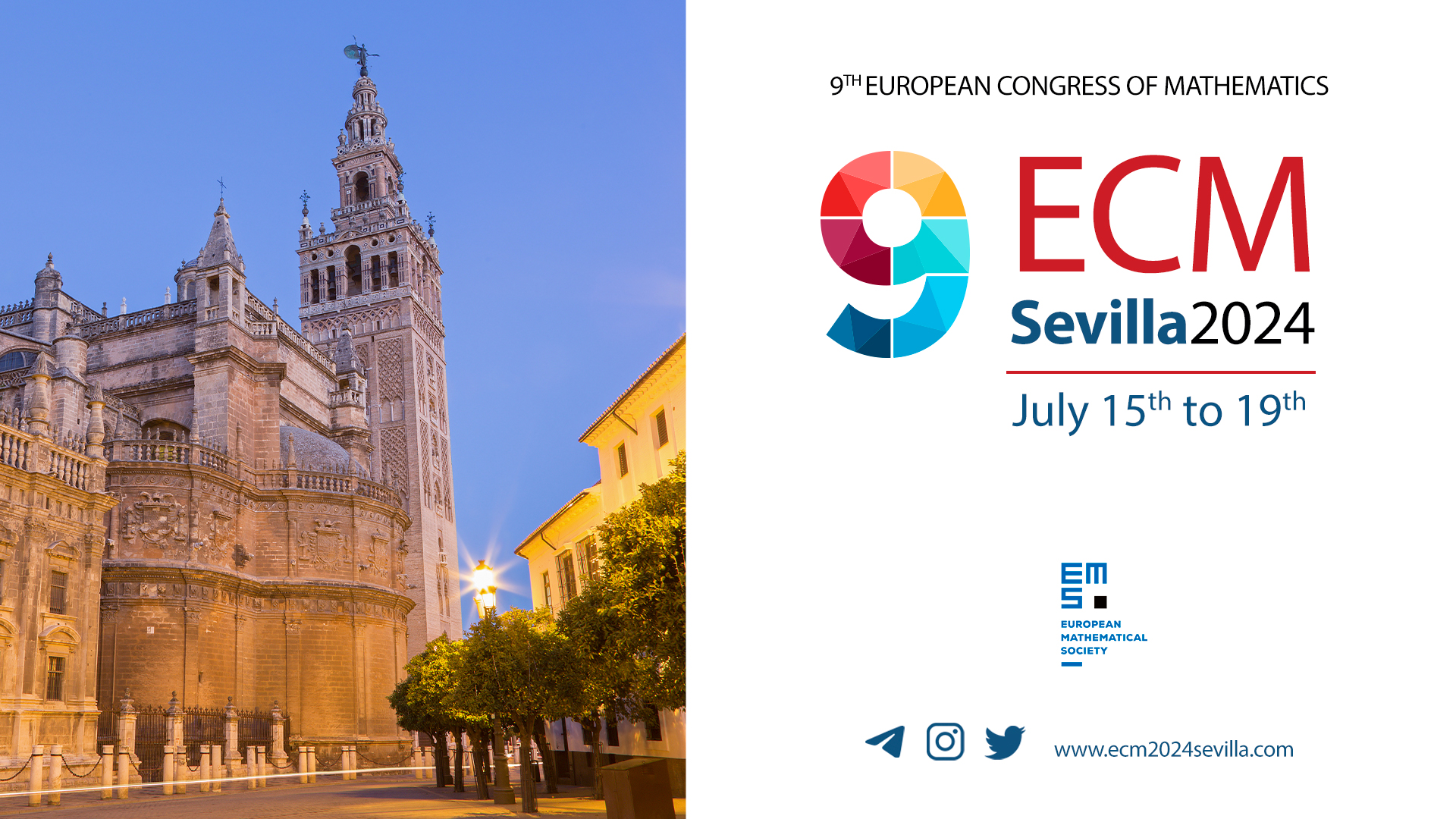
The ETSi will bring together more than 1,300 experts at the 9th European Congress of Mathematicians
The ETSi will bring together more than 1,300 experts at the 9th European Congress of Mathematicians
The European Congress of Mathematicians (ECM), considered the second most important in the world in this discipline and which takes place every four years in a European city, will be held in its ninth edition in Seville, between July 15 and 19, with the attendance of more than 1,300 participants.
This Congress is held under the auspices of the European Mathematical Society (EMS) and has come to Seville thanks to the bid submitted by the University of Seville (US). The president of the Organizing Committee, Professor Juan González-Meneses, championed the Seville project, which was ultimately selected in 2020, against the strong bid presented by Lisbon. The 9th ECM Seville 2024 benefits from the expertise of the Institute of Mathematics of the University of Seville (IMUS) and the Institute of Mathematics of the University of Granada (IEMATH-GR), both branches of the Andalusian Institute of Mathematics (IAMAT). Furthermore, it is an activity of the Cajal Year, organized by the Ministry of Science and Innovation.
The scientific event brings together some of the leading figures in European mathematics and serves as a meeting point for numerous researchers who have the opportunity to present and discuss the latest advances in their respective fields. The program includes 12 plenary lectures, 640 talks in mini-symposia, and 270 presentations in thematic sessions, in addition to roundtables, public lectures, activities for young researchers, and a cultural program that includes four exhibitions with mathematics as their central theme. And, undoubtedly, the most anticipated event: the awarding of the European Mathematical Society prizes, a total of 14 this year, which are the most important in Europe in mathematics and the second most prestigious in the world, after the internationally renowned Fields Medals.
Although Seville will be the main venue, specifically the Higher Technical School of Engineering of the University of Seville (ETSI), satellite events will be held throughout Spain and Portugal. Prior to this, the meeting of the Council of the European Mathematical Society (EMS) will take place in Granada on July 13 and 14.
Mathematics for monitoring tumors or designing the machines of the future
The lineup of mathematicians invited to give presentations at the event brings together the most prestigious internationally, such as Fields Medal winner Maxim Kontsevich, and will address diverse topics, both in basic and applied research, which, as González-Meneses states, "demonstrate that the mathematics being done today will change the lives of tomorrow.".
Among the most anticipated speakers is Avi Wigderson, a professor at the Institute for Advanced Study in Princeton, an expert in computer theory, algorithm design, cryptography, and quantum computing and communication, who will be in charge of delivering the special 'Abel Lecture'.
Fabio Toninelli, from the Vienna University of Technology, who in recent work has studied the equation known as KPZ (by Kardar, Parisi and Zhang), which models growth and aggregation processes, such as those of a tumor, a city or the way in which a crystal is formed by adding atoms from its surroundings.
Annalisa Buffa, a professor at the Ecole Polytechnique Federale de Lausanne and an expert in numerical analysis, has achieved outstanding advances in the development of computer simulations applicable to industry and machine design thanks to the use of mathematical tools.
Etienne Ghys, a mathematician and professor at the École Supérieure de Lyon and emeritus research director at the French National Centre for Scientific Research (CNRS), will also speak. His range extends from key achievements in geometry and chaos theory to popularizing the mathematics of soccer balls or snowflakes.
The public lectures will cover topics such as the search for neuroprotective therapy for Parkinson's disease, key moments in the history of mathematics, the scientific and technological challenges of nuclear fusion by magnetic confinement, and the alterations caused by invasive species.
Andalusia and Seville, at the international level
The University of Seville, and Andalusian public universities in general, boast world-class research in mathematics, as demonstrated by all research rankings. The organizers hope that holding this congress at the University of Seville will consolidate the international recognition of the research conducted at the institution and, at the same time, bring this work even closer to society, which is increasingly convinced of the important role mathematics plays in their lives and well-being. In general, Spanish mathematics occupies a prominent place in the European landscape, and globally, Spain ranks among the top ten countries in mathematical output.
This event will also benefit from the volunteer work of 100 mathematics students from various Spanish universities, and as part of the international cooperation program, a total of 120 scholarships have been awarded to young mathematicians or participants from developing countries. “The 9th ECM is committed to the goal of offering mathematicians who lack the necessary resources the opportunity to attend the congress,” says Mirta M. Castro Smirnova of the University of Seville.
Cultural agenda with a mathematical vision
As part of the cultural offerings associated with the 9th ECM, four exhibitions with mathematics as their central theme will also be on display during these days. One of them, “Maps: Cartographic Heritage in Seville from the 15th to the 18th Centuries,” will be located at the Cajasol Foundation in Seville. It is a curated collection of maps and map books from the period spanning the late Middle Ages and early Renaissance to the Enlightenment, originating from the Archive of the Indies, the Colombina Library, and the University of Seville.
The other three will be on display at the main venue, the Technical School of Engineering of Seville: “A Geometric Walk Through the Alhambra,” which explains some of the mathematical secrets present in the Alhambra of Granada; “Women in Mathematics From Around the World. A gallery of portraits,” which presents 34 comprehensive profiles of female mathematicians from around the world, through photographs, texts, and videos; and “Knots,” aimed at the general public, which features ten three-dimensional models of mathematical knots specially selected for their particularities, symmetries, and beauty, which will guide the visitor through the fascinating world of Knot Theory.


