
A group of students from ETSi qualifies for the final of the international Rohde & Schwarz Engineering Competition 2023
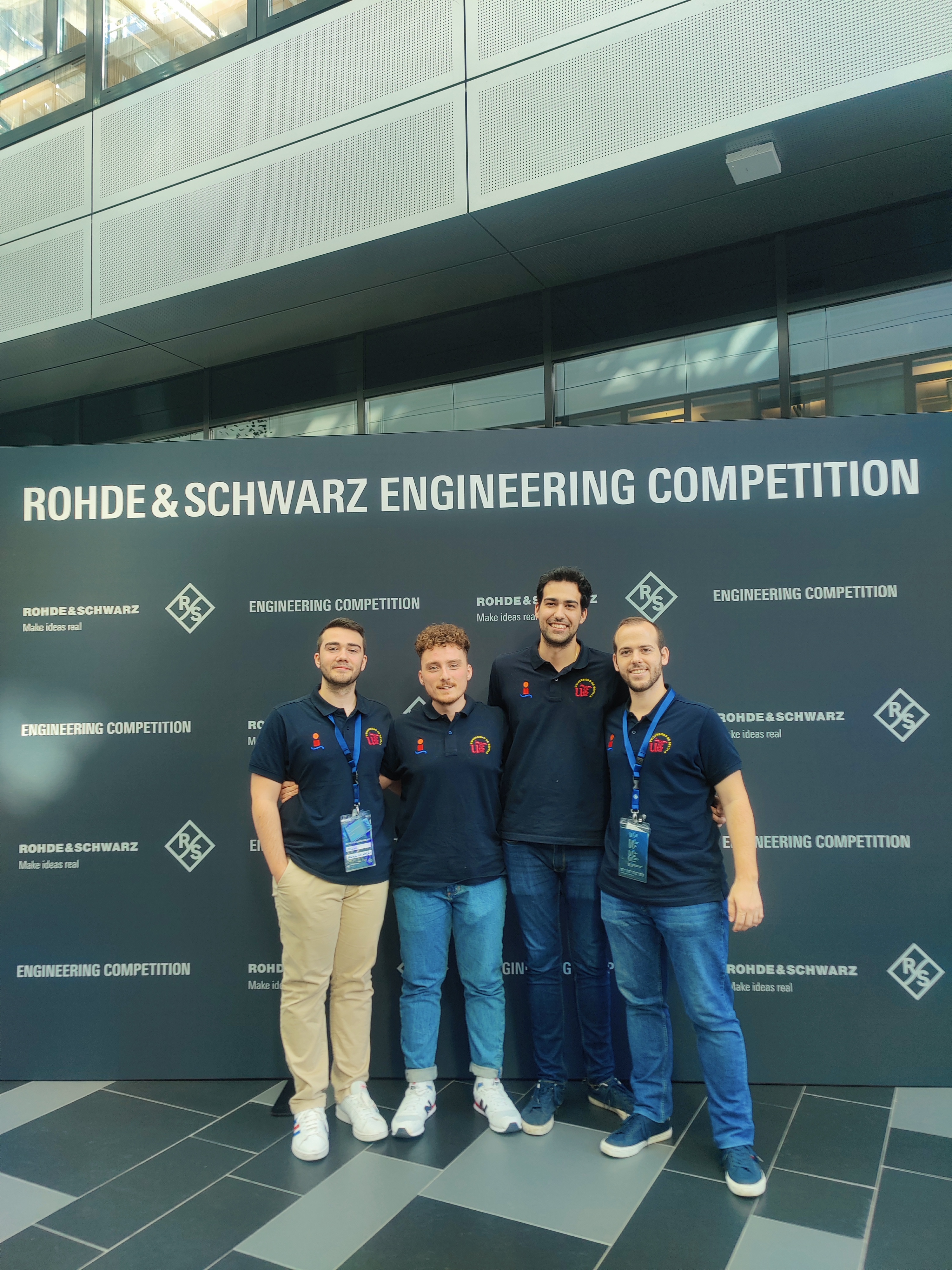
Rohde & Schwarz Engineering Competition 2023
Students from the Bachelor's Degree in Telecommunications Engineering and the Master's Degree in Telecommunications Engineering at the Higher Technical School of Engineering of the University of Seville, Marcos López García, Elías Marqués Valderrama, Iván Matas González and Miguel Nogales González-Regueral have managed to reach the final of the Rohde & Schwarz Engineering Competition 2023 , which will be held in Munich from June 13 to 16.
The Engineering Competition 2023 is an international competition organized for the past 19 years by Rohde & Schwarz, a leading company in communication and measurement technology. The competition's objective is to solve a real-world signal processing challenge by using the best combinations and settings of Rohde & Schwarz hardware engines to accelerate a signal processing pipeline and be the fastest at uncovering hidden components.
In the elimination phase to reach the final, the 20 selected teams had to perform the Discrete Fourier Transform (DFT) of a signal provided to them as quickly as possible, while maintaining the accuracy of the result.
The problem to be solved in the final is a mystery, as the final part of the competition is kept as a surprise for the participants, who will only learn the challenges they must overcome once they face them. It will involve the optimization of signal processing algorithms, but with a slight twist or change of perspective that maintains the essence of the qualifying round while adding more difficulty. The Engineering Competition is a highly competitive contest that demands intense concentration and a high level of expertise from the participating teams.
These types of competitions are important because they stimulate creativity, teamwork, and the practical application of theoretical knowledge. Furthermore, they offer an opportunity to meet other students and professionals in the field of engineering, as well as to discover the latest innovations in signal processing.
“From our personal experience, the most rewarding aspect has been seeing how, with the knowledge acquired during our degree, we were able to solve a problem that not only required programming skills but also a thorough understanding of the Fast Fourier Transform (FFT) technique, a skill we learned during our studies. Finally, we believe the best is yet to come. We have three exciting days ahead in Munich, where, in addition to testing our abilities, we will share experiences with other students from around the world, which will surely provide an unforgettable learning experience,” says Elías Marqués, one of the team members.


