
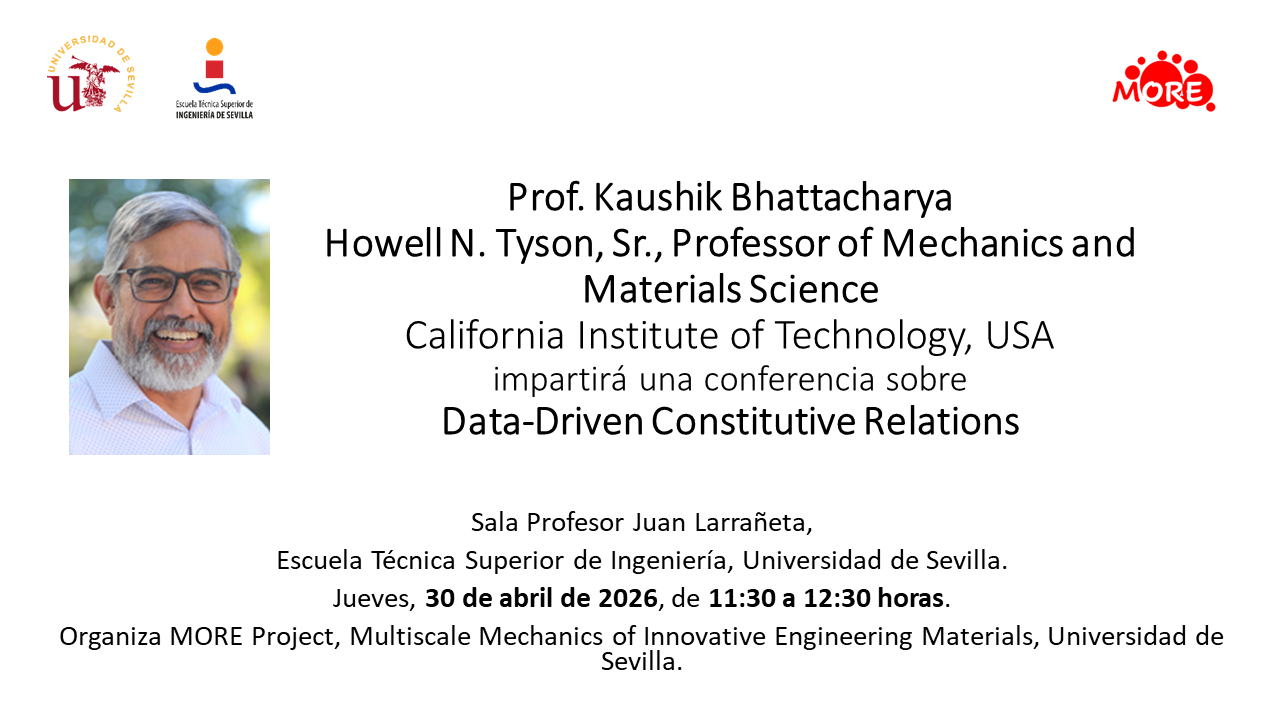
Conference on Data-Driven Constitutive Relations
Conference on Data-Driven Constitutive Relations by professor, Kaushik Bhattacharya, Howell N. Tyson, Sr., Professor of Mechanics and Materials Science California Institute of Technology, USA.
Place: Larrañeta Room, Higher Technical School of Engineering, University of Seville.
Date and time: Thursday, April 30, 2026, from 11:30 to 12:30.
Organized by: MORE Project, Multiscale Mechanics of Innovative Engineering Materials, University
Abstract: The numerical simulation of the mechanical behavior of complex materials and systems remains a significant engineering challenge. Despite advances in computer architecture, multiscale modeling and machine learning, most complex simulations of materials use a constitutive model at their core. This talk describes two approaches to learning high-fidelity constitutive models of complex materials.
The first approach is based on multiscale modeling where one recognizes that the effective behavior at the scale of applications is determined by physics at multiple length and time scales: electronic, atomistic, domains, defects etc. The data-driven constitutive relation is obtained as a neural approximation that is trained using data generated by repeated solution of the small scale problem. A key innovation is learning approximations that are independent of discretization. The second approach seeks to infer the constitutive relations from experiments. Even as advances in experimental techniques that enable observations with unprecedented range and resolution have brought about an ever increasing stream of raw data, we remain poor in interpreted quantitative data that can be used to build models. We describe an approach that enables us to extract the underlying information from experimental observation, and to optimally design experiments to minimize the uncertainty in the model.
Short Bio: He received his B.Tech degree from the Indian Institute of Technology, Madras, India in 1986, his Ph.D from the University of Minnesota in 1991 and his post-doctoral training at the Courant Institute for Mathematical Sciences during 1991-1993. He joined Caltech in 1993. He has received the von Kármán Medal of the Society of Industrial and Applied Mathematics (2020), Distinguished Alumni Award of the Indian Institute of Technology, Madras (2019), the Outstanding Achievement Award of the University of Minnesota (2018), the Warner T. Koiter Medal of the American Society of Mechanical Engineering (2015) and the Graduate Student Council Teaching and Mentoring Award at Caltech (2013).


