
They develop a fast and contactless method for monitoring pharmaceutical contaminants in rivers and drinking water
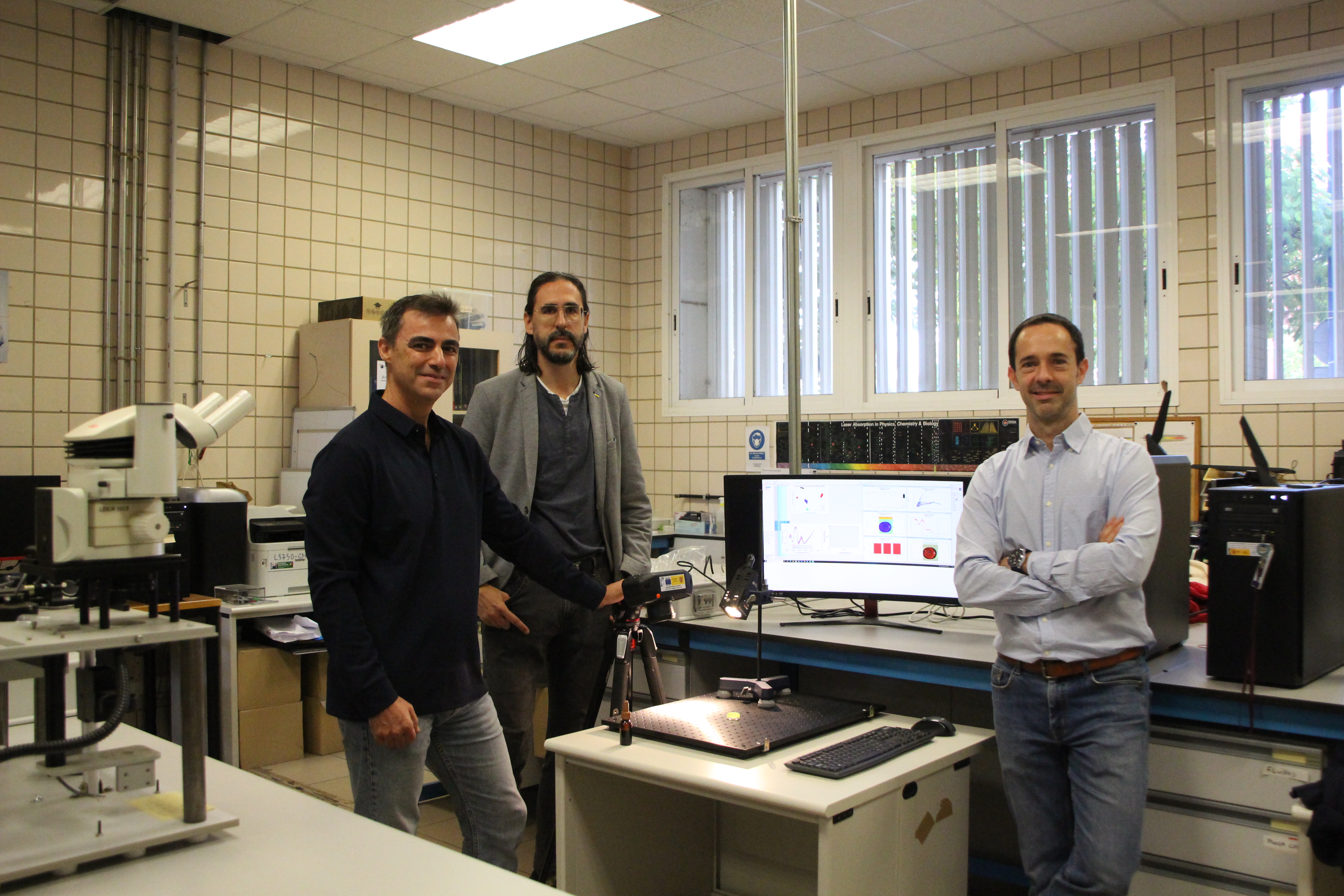
A scientific team comprised of researchers from the Department of Applied Physics III and the Department of Chemical and Environmental Engineering at the Higher Technical School of Engineering of the University of Seville, in collaboration with the EOD-CBRN Group of the National Police (TEDAX), has successfully validated an exceptionally rapid chemical and environmental monitoring tool for detecting ibuprofen in bodies of water. This collaboration combines university expertise in applied optics and chemical engineering with the National Police's operational need to identify potentially hazardous substances non-invasively.
The technology proposed by researchers José Manuel Navas García, Bernabé Alonso Fariñas, and Alejandro Barriga Rivera, which can be described as a 'camera that sees beyond light,' captures the optical information of the sample using advanced imaging and separates the signal from the molecules of interest from that of other molecules present in the sample. This allows for the identification of compounds without the need for physical contact, sample preparation, or the use of reagents. The key advance of the study lies in the combination of hyperspectral imaging, a type of photography that captures light reflected in the visible and infrared spectrum, with an advanced mathematical technique known as the Wavelet Transform. This transform acts as a powerful digital filter capable of separating the details that carry significant information from the noise in the sample generated by the other chemical compounds.
The study validated the technology's effectiveness in detecting ibuprofen at a critical concentration of 60 μg/L. This concentration represents a relevant level for monitoring high-risk environmental scenarios; it is known as the expected no-effect concentration (EBC), which establishes the limit above which adverse effects are expected in an ecosystem. The researchers tested the methodology in various liquid matrices, including bottled water, tap water (from Seville), an ethyl alcohol solution, and, specifically, water from the Guadalquivir River. In the case of river water, the most complex matrix, detection accuracy improved from 55% using traditional methods to 100% using the computational processing designed by the researchers.
Future Environmental Monitoring:
As a rapid method requiring no sample preparation, the technology developed at the University of Seville has enormous potential for deployment as a real-time monitoring tool for the continuous detection of emerging contaminants. This methodology has the potential to be deployed on autonomous aerial vehicles, thus enabling monitoring in hard-to-reach regions such as wetlands, lakes, and rivers.
This line of research began at the University of Seville under the direction of Professor Emilio Gómez González, Chair of the Department of Applied Physics III, who passed away in 2023. Initially, the researchers developed methods for detecting viral particles, including SARS-CoV-2, the virus that causes COVID-19, using hyperspectral imaging and artificial intelligence (in the form of artificial neural networks). The researchers in the Interdisciplinary Physics group continue to develop technological strategies that help improve people's lives in the field of medical technology.
The Risk of Emerging Contaminants
: Ibuprofen, a widely consumed anti-inflammatory drug (with a reported annual production of approximately 45,233 tons in 2022), is one of the most frequently detected active pharmaceutical ingredients in fresh and salt water. This is because conventional wastewater treatment plants only partially remove the compound, typically between 30% and 60%. This persistence makes ibuprofen an emerging contaminant that, along with other medications, poses a significant threat to ecosystems and public health, as it can affect crucial biological functions in aquatic organisms, even at minimal concentrations. The need to monitor these compounds is global, with ibuprofen having been detected even in remote regions such as Antarctica.
Beyond Contaminants: Hazardous Substances.
The collaboration with the National Police's EOD-CBRN Group (TEDAX) underscores the broad potential of this "chemical scanner." This technology works by identifying the "chemical fingerprint" or spectral barcode of the substance of interest. The ability to non-invasively identify and quantify chemical compounds in fluids, even in complex matrices, has a direct impact on public safety, offering a platform for the potential rapid detection of other hazardous or illicit substances, such as chemical agents or explosive residues dissolved in fluids, safely and without contact.


